
Educational Toys 2026: A Guide to Choosing for Child Development
Educational toys serve as tools for fostering cognitive, motor, and social skills in children. The selection of a suitable product is based on an analysis of its material, educational concept, and age-appropriate functionality. A functional educational toy is characterised by its ability to challenge a child without being overwhelming or underwhelming, while also encouraging repeated, independent play.
What to Look for When Choosing Educational Toys
The decision to purchase a toy should be based on objective criteria. The following parameters are relevant for making an informed choice.
1. Age Appropriateness and Developmental Stage
The manufacturer's age recommendation is a primary indicator. Toys for ages 3 and up are typically designed to be free of small parts that pose a choking hazard and to address the motor skills of this age group. For preschool-aged children, preschool toys that target the acquisition of foundational skills such as counting, letter recognition, or logical matching are suitable. The complexity of the tasks should correspond to the child's individual developmental level to avoid frustration and maintain the flow of play.
2. Material, Workmanship, and Safety
Within the European Union, toys must meet the requirements of the Toy Safety Directive 2009/48/EG, which is documented by the CE marking. Look for robust construction, rounded edges, and the use of non-toxic materials. For toys with reusable components, such as a children's sticker book or a Busy Book, the durability of the materials is a crucial factor for its lifespan.
3. Educational Approach and Functionality
An educationally valuable toy promotes specific skills.
- Motor skills toys: Train hand-eye coordination and fine motor skills through grasping, stacking, or threading.
- Creative toys for children: Allow for free expression without rigid rules, as is the case with an LCD writing tablet.
- Structured learning toys: Offer clear tasks to promote logical thinking and concentration, typical of a Busy Book.
4. Portability and Use Case
For on-the-go use, travel toys for children are a practical category. Criteria for this include a compact size, a lightweight design, and the ability to store all parts securely to prevent loss. Reusable and screen-free activities are often suitable for travel or waiting times.
Our Product Selection for 2026
Based on the criteria mentioned above, we present a selection of products that stand out for their specific features and applications.
CHEERFUN Pink Cat LCD Writing Tablet
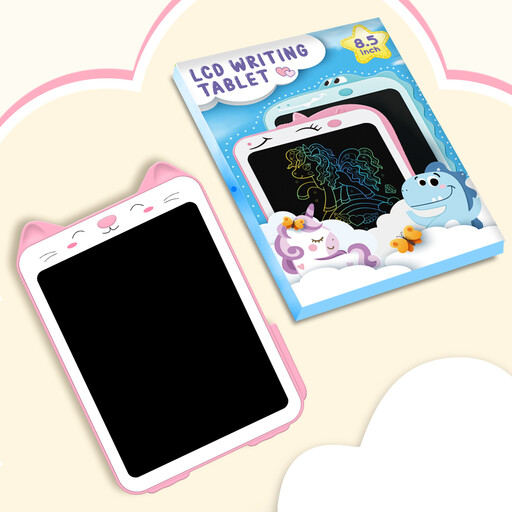
Why we recommend this product The CHEERFUN LCD Writing Tablet is a digital and paperless alternative to traditional drawing. The device uses a pressure-sensitive screen that allows children to create lines of varying thickness with the included stylus. Its functionality is enhanced by an erase button for instantly clearing the screen and a lock key to prevent accidental deletion. The lightweight and portable design makes it a practical companion.
Benefits
- Reusability: Reduces paper consumption and can be used indefinitely.
- Ease of Use: Intuitive operation with a one-click erase function.
- Portability: Lightweight and slim design for easy transport.
- Fosters Creativity: Provides a blank canvas for drawings, notes, and writing practice.
Who it's for This product is suitable for children aged 3 to 8 who enjoy drawing and writing. It is an excellent option as a travel toy for children or as a gift for children for various occasions.
Reusable Sticker Book (3-Pack)
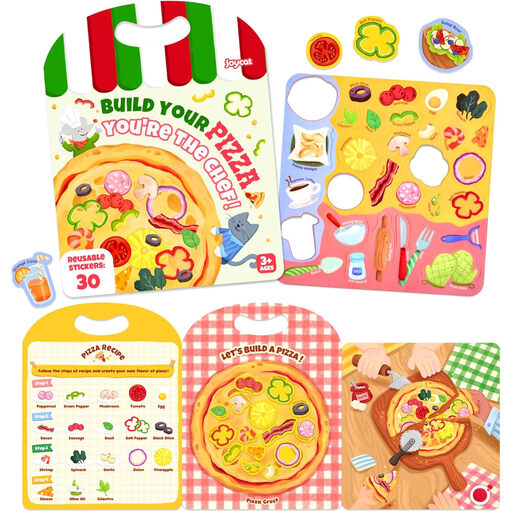
Why we recommend this product This set includes three themed sticker books (Farm, Pizza, Weather) with a total of 90 reusable gel stickers. The stickers adhere to the book pages as well as other smooth surfaces like windows or refrigerators and can be removed and repositioned without leaving residue. The material is waterproof and washable. The design, featuring an integrated carrying handle and sticker storage, makes it an ideal travel toy.
Benefits
- Promotes fine motor skills: Peeling and placing the stickers trains hand-eye coordination.
- Thematic learning: Supports vocabulary building and understanding of contexts.
- Reusable and durable: The washable stickers ensure a long lifespan.
- Compact and travel-friendly: All components are integrated into one book.
Who it's for Ideal for toddlers and preschoolers looking for a quiet, screen-free, and creative activity. It functions as a motor skills toy and its design makes it a practical on-the-go toy.
Preschool Busy Book (STEAM)
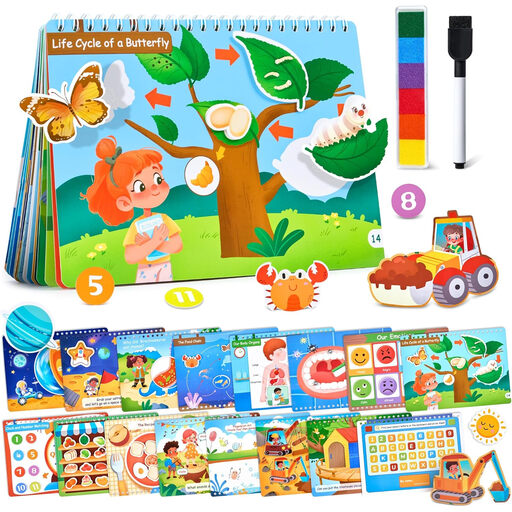
Why we recommend this product This Busy Book is focused on STEAM (Science, Technology, Engineering, Art, Math) learning content and offers 20 interactive themes. The system is based on laminated pages and reusable hook-and-loop elements. Children match cards, complete pictures, or follow patterns, which promotes problem-solving skills and logical thinking. The product requires a one-time setup to attach the hook-and-loop dots to the cards and in the book.
Benefits
- Structured learning approach: Covers a wide range of STEAM topics.
- Interactivity: The hook-and-loop components encourage active participation and tactile learning.
- Cognitive development: Trains skills such as matching, categorisation, and concentration.
- Reusable: The laminated pages and hook-and-loop pieces are designed for repeated use.
Who it's for This learning book is designed for preschoolers aged 4 to 5. It is a useful tool for homeschooling, school preparation, or as a sensory toy, including for children on the autism spectrum.
Discover More Options
The products presented here cover specific use cases. If you are looking for further alternatives or other toy categories, you can find a wider selection in our range of Toddler Boy Toys.
Frequently Asked Questions (FAQ)
1. What makes a toy educationally valuable? An educationally valuable toy is distinguished by its ability to specifically promote one or more skills beyond pure entertainment. These include motor skills, cognitive processes like logical thinking and problem-solving, creativity, or social interaction. It is adapted to the child's developmental stage and encourages active engagement.
2. From what age are educational toys useful? Educational toys are beneficial from infancy, with the type and complexity changing with age. For babies, these are teethers or mobiles for sensory stimulation. Toys for ages 3 and up often focus on fine motor skills, simple puzzles, and role-playing games. In the preschool years, they become more complex and prepare children for school-related subjects.
3. How do you clean educational toys like sticker books or Busy Books? Cleaning depends on the material. Laminated pages of a Busy Book can be wiped with a damp cloth. Reusable gel stickers, like those in the featured sticker book, can be rinsed under cool water to remove dirt, according to the manufacturer's instructions. After air-drying, their adhesiveness should be restored.