
Educational Toys 2026: A Guide to Choosing Developmental Toys
Educational toys, also known as developmental toys, are designed to support a child's development in specific areas. Unlike toys intended purely for entertainment, they integrate educational components that target cognitive, motor, or creative skills. Selecting the right product depends on developmental goals, the child's age, and material properties.
What to Look for When Choosing Educational Toys
The decision to purchase a specific educational toy should be based on objective criteria. The following aspects are relevant for making an informed choice:
1. Material Quality and Safety Standards
A child's safety is the primary factor. In the European Union, toys must meet the requirements of the Toy Safety Directive 2009/48/EC and bear the CE marking. This mark indicates that the product meets essential health and safety requirements. Look for materials that are free from harmful substances like BPA or phthalates. Information regarding compliance with standards such as the REACH Regulation (Registration, Evaluation, Authorisation and Restriction of Chemicals) provides additional assurance. Robust and durable materials like high-quality ABS plastic or well-finished wood ensure a longer lifespan.
2. Age-Appropriate Design and Complexity
A toy can only reach its full potential if it is tailored to the child's developmental stage. Under-stimulation leads to disinterest, while over-stimulation can cause frustration. Manufacturers typically provide an age recommendation that serves as a guide. Check whether the complexity of the tasks (e.g., in brain games for kids) or the fine motor skill requirements (e.g., in motor skills toys) are appropriate for the child's age.
3. Educational Focus and Skill Development
Educational toys specialise in fostering specific competencies. Analyse which area you want to specifically support:
- STEM Toys: Promote skills in Science, Technology, Engineering, and Math. Typical examples include construction sets, programming robots, or logic puzzles.
- Creative Toys: Stimulate imagination and artistic expression. These include drawing boards, craft kits, or modelling clay.
- Motor Skills Toys: Help train gross and fine motor skills. Pegging games, lacing beads, or balance boards fall into this category.
4. Practicality and Use Cases
Everyday usability is a crucial criterion. For families who travel frequently, compact travel games for kids are ideal. Products that come without small loose parts or are supplied in their own carrying case are advantageous. Screen-free toys offer an alternative to digital devices and help improve concentration.
Our Selection of Educational Toys for 2026
Based on the criteria above, we have compiled a selection of products that stand out for their specific features and functional benefits.
GiiKER Super Blocks Pattern Matching Puzzle Games
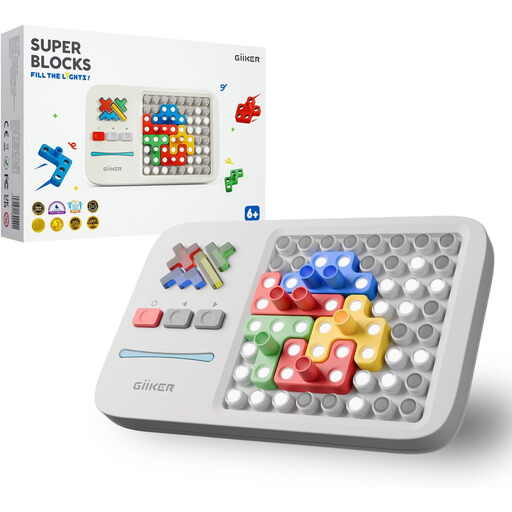
Why We Recommend This Product The GiiKER Super Blocks is a screen-free electronic logic game. It combines the tactile feel of classic puzzles with interactive, light-up challenges. The player must place coloured blocks on the board to match the patterns shown on the LED display. This principle specifically promotes spatial reasoning and problem-solving skills.
Advantages
- Progressive Difficulty: With over 1,000 built-in challenges in both a learning and a challenge mode, the game adapts to the user's skill level.
- Boosts Cognitive Skills: Specifically trains logical thinking, planning, and problem-solving.
- Portability: Its compact handheld format (18.3 x 11.4 x 2.5 cm) makes it an ideal travel game.
- No Batteries Required: The device is rechargeable, making its operation more sustainable.
Who It's For This brain game is suitable for children aged 6 and up, as well as for teenagers and adults looking for a challenging, screen-free activity. It is particularly appealing to those who enjoy logic riddles and puzzles.
Purple LCD Writing Tablet for Kids
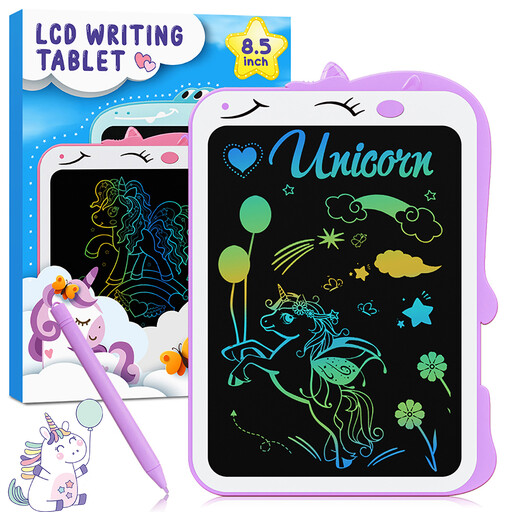
Why We Recommend This Product This 8.5-inch LCD writing tablet offers a clean and reusable surface for creative activities. It allows for drawing and writing in multiple colours without the need for paper, pens, or chalk. The entire drawing surface can be instantly erased at the touch of a button, making it a practical tool for home and on the go.
Advantages
- Safe Material: According to the manufacturer, the casing is made of eco-friendly, non-toxic ABS plastic and is free from BPA, lead, and formaldehyde. It complies with the EU REACH Regulation.
- Lightweight and Ergonomic: Weighing just 105 grams and featuring rounded edges, the tablet is designed for children's hands.
- Versatile Use: Functions as a drawing board, notepad, or travel game. Its slim design (0.7 cm thick) makes it easy to transport.
- Durable and Clean: The moisture-resistant casing is resilient against drops. It creates no ink stains or paper waste.
Who It's For The writing tablet is designed for children aged 3 to 8. It is an excellent choice for parents seeking a clean, creative, and screen-free activity for car rides, restaurant visits, or quiet moments at home.
Preschool Busy Book for Toddlers
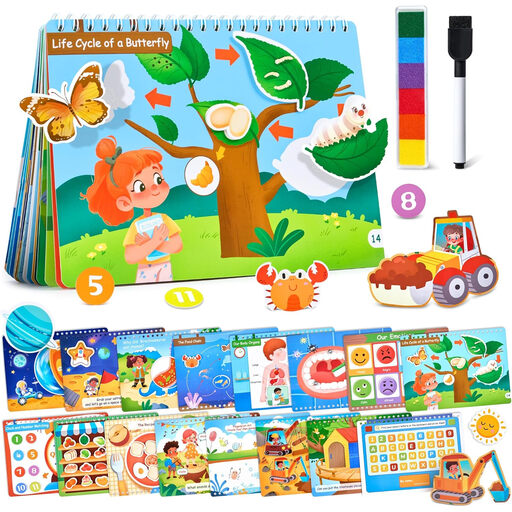
Why We Recommend This Product This interactive "Busy Book" is an educational book based on the STEAM approach. It includes 20 different themes, such as space, dinosaurs, and the water cycle. By matching Velcro-backed cards, it promotes fine motor skills, hand-eye coordination, and cognitive abilities like pattern recognition and problem-solving.
Advantages
- Interactive and Reusable Design: The laminated pages and removable Velcro cards allow for repeated use and encourage independent play.
- Broad Range of Topics: The content covers Science, Technology, Engineering, Arts, and Math, sparking curiosity in various fields of knowledge.
- Develops Key Competencies: The book playfully trains fine motor skills, cognitive development, and problem-solving abilities.
- Versatile Learning Tool: Suitable for homeschooling, preschool education, or as a quiet activity during travel.
Who It's For The book is aimed at children aged 4 to 8. It is a valuable resource for parents and educators looking for a structured yet playful learning activity. Due to its sensory tasks, it can also be a supportive tool for children with autism.
More Gift Ideas and Alternatives
If you are looking for specific gift options, such as gifts for kids for a particular occasion, you can find a wider selection of products in our Birthday gift for girl child category.
Frequently Asked Questions (FAQ)
1. What is the difference between educational toys and regular toys? The main difference lies in the design focus. While any toy can have some learning effect, educational toys are specifically designed to develop one or more particular skills. The game mechanics are directly linked to a didactic goal, whether it's promoting logic, motor skills, or creativity.
2. At what age are STEM toys beneficial? Simple STEM toys can be introduced as early as the preschool years (from ages 3-4). These include basic building sets, magnetic blocks, or sorting games that teach fundamental concepts of physics and mathematics. More complex sets involving programming or advanced construction are typically designed for primary school-aged children and older.
3. How do you clean educational toys made from different materials? Plastic toys can usually be cleaned with a damp cloth and a mild soap solution. Wooden toys should only be wiped with a slightly damp cloth and dried immediately to prevent the material from swelling. For electronic toys, cleaning should be limited to the casing's surface, ensuring no liquid gets inside. Always follow the manufacturer's specific care instructions.