
Desk Fan Buyer's Guide 2026: Technical Criteria for Making the Right Choice
A desk fan provides targeted air circulation in your immediate vicinity, offering a refreshing breeze at your workspace or in your living area on warm days. Selecting the right model depends on a range of objective technical parameters that go beyond pure cooling power. These include operating noise, energy efficiency, size, and the type of air distribution. This article analyses the key criteria and presents a selection of models with different technical strengths.
Buyer's Guide: What to Look for in a Desk Fan
Your decision should be based on an analysis of your specific needs and the fan's technical specifications. The following criteria are essential for making an informed choice.
Airflow and Cooling Performance (m³/h)
A fan's primary function is to move air. Its performance is often specified in cubic metres per hour (m³/h) or litres per second (l/s). A higher value indicates stronger air circulation and potentially greater reach. For a desk fan, a moderate airflow is sufficient, whereas cooling a larger area of a room requires a model with a higher airflow rate.
Operating Noise (Decibels, dB)
The noise level is a critical factor, especially for use in an office or as a bedroom fan. The sound pressure level is measured in decibels (dB).
- Under 30 dB: Considered very quiet and suitable for noise-sensitive environments like a bedroom.
- 30 to 40 dB: Comparable to a soft whisper. Such a quiet fan generally won't disturb focused work.
- Over 45 dB: Can be perceived as disruptive during continuous operation.
Size and Power Source
The dimensions determine where the fan can be placed. A small fan with a compact footprint fits easily on a crowded desk or a nightstand. The power source is also relevant. Traditional models require a 230V mains connection, while a USB fan offers flexibility, running off a laptop, power bank, or USB adapter, which enhances its portability.
Oscillation and Air Distribution
An oscillating fan swivels horizontally to distribute air over a wider area instead of concentrating it on a single point. The oscillation angle (e.g., 70°, 90°, or even 360°) indicates the size of the coverage area. Some models also offer vertical tilt to precisely direct the airflow.
Additional Features and Ease of Use
Modern desk fans often come with extra features that enhance user comfort. A fan with a remote control allows you to adjust speed, oscillation, or timer functions from a distance. Timers are useful for automatically switching the device off after a preset time. Special modes like "Nature" or "Sleep" vary the airflow intensity to simulate a natural breeze or to ensure extra-quiet operation.
Our Top Desk Fan Picks for 2026
Based on the technical criteria above, we have compiled a selection of three models, each with a different functional focus.
Aigostar Portable USB Fan
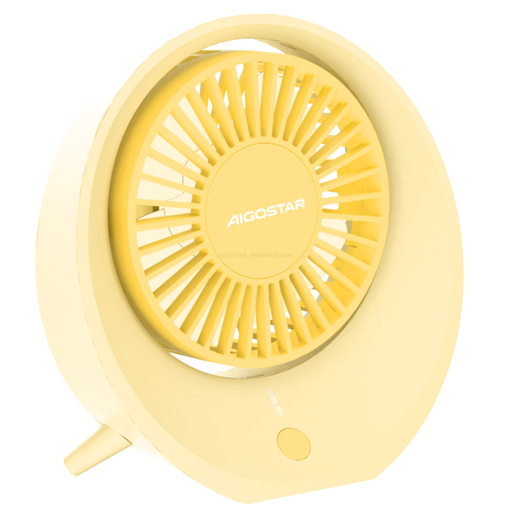
Why We Recommend This Product: This model stands out for its high portability and flexible USB operation. With a blade diameter of 104 mm and a low power consumption of 3 watts, it is designed for direct personal use. The 4-blade design creates a soft, directional airflow.
Advantages:
- Highly Portable: Thanks to its integrated battery and USB charging capability, the fan can be used anywhere.
- Low Energy Consumption: At 3 watts, its operation is very energy-efficient.
- Compact Design: Fits on any desk and is easy to transport.
- Simple Operation: Three speed levels are controlled via a single button.
Best Suited For: Users looking for a straightforward and mobile cooling solution for their immediate workspace, for travel, or as a personal small fan next to the bed.
Dyson Cool CF1 Desk Fan
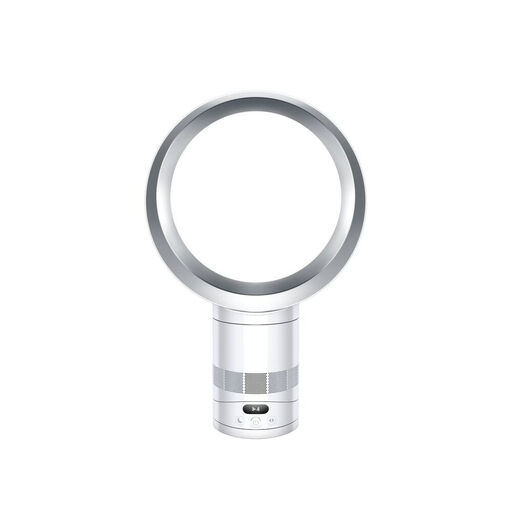
Why We Recommend This Product: The Dyson Cool CF1 uses Air Multiplier technology to generate a smooth, powerful stream of air without any visible blades. This enhances safety and simplifies cleaning. The dedicated sleep mode, with a noise level of 29 dB (according to the manufacturer), makes it an excellent option for noise-sensitive environments.
Advantages:
- Safety: The bladeless design eliminates the risk of injury from spinning blades.
- Quiet Operation: The sleep mode is optimised for bedroom use at just 29 dB.
- Precise Control: A remote control and 70° oscillation allow for accurate airflow direction.
- Easy to Clean: The smooth surfaces can be simply wiped down.
Best Suited For: Households with children or pets, design-conscious buyers, and individuals who prioritise quiet operation, especially for a bedroom fan.
Monsga AC200 Turbo Table Fan
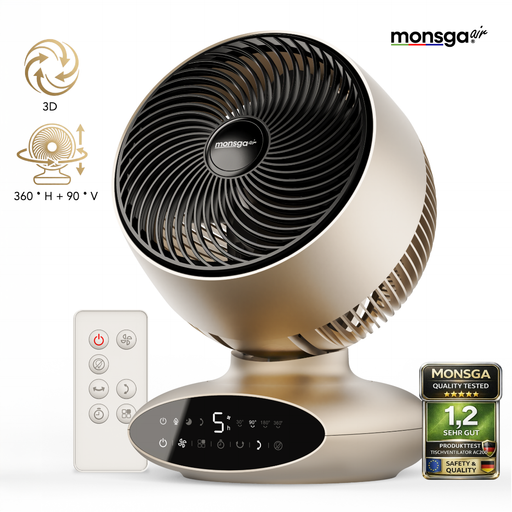
Why We Recommend This Product: This model is designed as an air circulator, offering comprehensive air distribution throughout the entire room with its 3D oscillation (90° vertical, up to 360° horizontal). The combination of a long range (up to 25 m, according to the manufacturer) and a quiet operating mode (from 30 dB) makes it highly versatile.
Advantages:
- Comprehensive Air Circulation: The dual oscillation effectively distributes air throughout the room, not just in one spot.
- Highly Customisable: Five speed settings, three modes, an 8-hour timer, and a remote control offer maximum control.
- Quiet Operation: At 30 dB on its lowest setting, it is suitable for living rooms and bedrooms.
- Easy Maintenance: The removable grilles and fan blades facilitate thorough cleaning.
Best Suited For: Tech-savvy users seeking a powerful air circulator to regulate the temperature of entire rooms and who value a wide range of features like a timer, various modes, and a remote control.
Other Options and Alternatives
For users who place a special emphasis on minimalist design and enhanced safety, other bladeless models could be an interesting alternative. You can find a selection of such devices in our Bladeless Desk Fan category.
Frequently Asked Questions (FAQ)
1. What is a good dB rating for a quiet desk fan? A value below 40 decibels (dB) is generally considered quiet for an office environment. For use in the bedroom, where background noise is more noticeable, models with a sound pressure level of 30 dB or less are recommended.
2. How much power does a desk fan use? Power consumption varies depending on the model and power level. Small USB fans often require only 3 to 5 watts. Larger, more powerful desk fans typically consume between 20 and 40 watts on their highest setting. The exact figures can be found in the technical specifications of the respective product.
3. What does oscillation mean for a fan? Oscillation refers to the pivoting, usually horizontal, movement of the fan head. This feature ensures that the airflow is not directed at a single point but is distributed over a wider area. This results in a more even and pleasant air circulation in the room.