
Dehumidifier Buyer's Guide 2026: Finding the Right Model for Your Home
Consistently high humidity in living spaces can lead to problems like mould growth, musty odours, and damage to the building's structure. An electric dehumidifier is a device designed to lower the relative humidity in enclosed spaces to an optimal level. By reducing excess moisture, it eliminates the conditions for mould growth and noticeably improves the indoor climate. Selecting the right unit depends on various technical parameters and the specific application.
Written by: Joybuy Product Recommendation Officer
What to Consider When Choosing a Dehumidifier
The decision to buy a dehumidifier should be based on an analysis of your needs and the technical specifications of the available models. The following criteria are crucial for making an informed choice.
Dehumidification Capacity and Room Size
The dehumidification capacity, measured in litres per 24 hours (L/day), is the key performance metric. It describes how much water the device can extract from the air under specific conditions (usually 30°C and 80% relative humidity).
- Small rooms (up to 20 m²): For bathrooms or small storage areas, models with a capacity of up to 10 L/day are often sufficient.
- Medium-sized rooms (20–50 m²): Living rooms or larger bedrooms require units with a capacity between 12 and 20 L/day.
- Large rooms and basements (from 50 m²): For a basement, open-plan living areas, or acute moisture problems, models for large rooms with a capacity of 20 L/day or more are recommended.
Features: More Than Just Dehumidifying
Modern devices often offer useful additional features that enhance their practical value.
- Dehumidifier with Air Purifier: Combination units not only remove moisture but also filter dust, pollen, viruses, and other particles from the air. This is particularly relevant for allergy sufferers and health-conscious households.
- Dehumidifier with Laundry Mode: A special mode with maximum fan and dehumidification power significantly speeds up drying laundry indoors, preventing a rise in room humidity.
- Smart Home Integration: Models with Wi-Fi connectivity can be controlled via an app. This allows for remote monitoring of humidity levels and adjustment of settings, even when you're away from home.
Operating Noise and Water Disposal
- Noise Level: The operating noise is specified in decibels (dB). For use in bedrooms or living rooms, quiet models with levels below 45 dB are recommended. This factor is less critical in a basement or laundry room.
- Water Disposal: By default, the condensed water is collected in an integrated tank that must be emptied manually. For continuous operation, such as in a basement, a dehumidifier with a hose connection for continuous drainage is a practical alternative.
Our Top Dehumidifier Picks for 2026
Based on technical specifications and feature sets, here are three models for different applications.
1. Philips Dehumidifier and Air Purifier DE5305/11 5000 Series
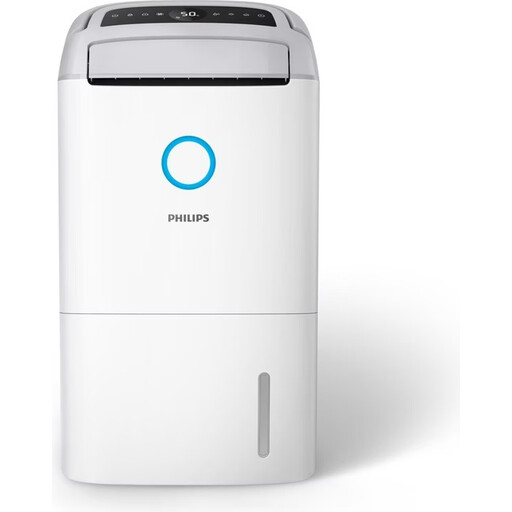
Why We Recommend This Product The Philips DE5305/11 is a 2-in-1 combination unit that offers both high-level dehumidification and air purification. Its AeraSense sensor technology monitors air quality in real-time and automatically adjusts performance. The HEPA filter is designed to capture particles as small as 0.003 microns.
Pros
- Combination Function: Dehumidifies and purifies the air simultaneously or separately.
- Powerful Filtration: According to the manufacturer, the HEPA filter removes 99.9% of viruses and aerosols from the air.
- High Dehumidification Capacity: Up to 26.5 litres per day, suitable for rooms up to 137 m³.
- Special Modes: Features an automatic, continuous, and a dedicated laundry mode.
Who It's For This model is ideal for households that prioritise a comprehensive improvement in indoor air quality, especially for families and individuals with allergies.
2. VINO Smart Dehumidifier 20L/Day
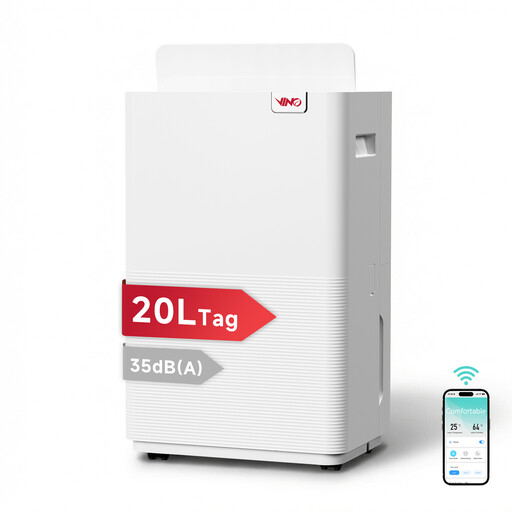
Why We Recommend This Product The VINO dehumidifier combines solid dehumidification performance with modern smart home features. Control via an app and the inclusion of a quiet sleep mode make it a versatile device for modern living. The plasma purification function adds extra value.
Pros
- Smart Control: Full operation and scheduling via a Wi-Fi app.
- Quiet Operation: Sleep mode reduces the noise level to 35 dB, making it suitable for use in the bedroom.
- Additional Air Purification: Integrated plasma purification and an antibacterial filter improve air quality.
- Thoughtful Design: Automatic internal drying function to prevent mould growth inside the unit itself.
Who It's For This device is aimed at tech-savvy users who appreciate convenient remote control and an especially quiet operation for living rooms and bedrooms.
3. ELECCI 60L/D Dehumidifier
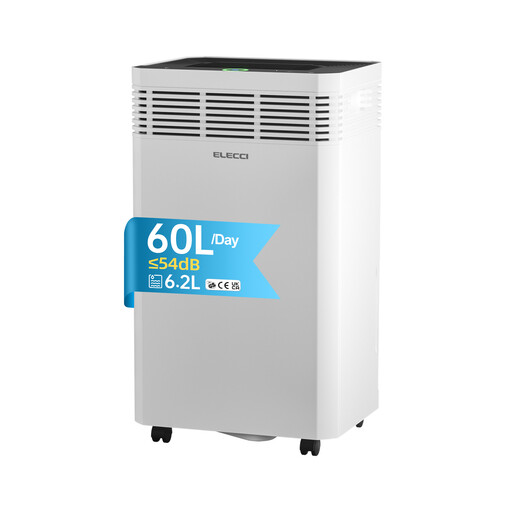
Why We Recommend This Product The ELECCI dehumidifier is engineered for maximum performance. With a dehumidification capacity of up to 60 litres per day, it is designed for the most demanding tasks, such as drying large basements, new builds, or after water damage.
Pros
- Extreme Dehumidification Capacity: Up to 60 L/day for rooms up to 120 m².
- Large Water Tank: The 6.2-litre tank reduces the frequency of manual emptying.
- Continuous Operation Possible: A hose connection for continuous drainage is included.
- Robust Design: Built for use in demanding environments like construction sites or a damp basement.
Who It's For This high-performance model is the right choice for users with very high dehumidification needs, such as for large rooms, basements, garages, or for construction drying.
Discover More Models
The products featured cover specific use cases. If you are looking for a device with different specifications or for a different budget, you can find a wider selection in our main category.
Find more dehumidifiers and air purifiers here
Frequently Asked Questions (FAQ)
1. What is the ideal humidity level for a home? A relative humidity between 40% and 60% is considered ideal for living rooms and bedrooms. It can be temporarily higher in the kitchen and bathroom but should be brought back down by ventilating or using a dehumidifier. Levels consistently above 60% encourage mould growth.
2. Does a dehumidifier help with mould? A dehumidifier does not combat existing mould, but it does eliminate its breeding ground. By lowering the humidity to a low level, the new growth and spread of mould can be effectively prevented. Removing an existing infestation requires separate measures.