Joybuy Insights

Buying crispbread again: check fibre, ingredients and allergens

For a quick restock, wholegrain rye crispbread with a straightforward ingredients list is a sensible choice if you mainly want to compare fibre content. The key things to check are the nutrition information per 100 g and the details on the specific pack: a higher fibre content alone says nothing about how well you personally tolerate it, and rye is not gluten-free.

Who should check what on the pack?

If you’re keeping an eye on fibre

If you buy crispbread regularly, compare the fibre per 100 g rather than relying on the word ‘wholegrain’. The German Nutrition Society includes wholegrain products among foods rich in fibre; the specific amount is listed in the product’s nutrition information.

If you need to check ingredients or allergens

If you need to avoid gluten-containing cereals or other allergens, check the ingredients list and any ‘may contain’ statements on the pack. The Federal Office of Consumer Protection and Food Safety lists rye as a gluten-containing cereal; any other warnings depend on the product.

If you’re picking up a pack in store

If you’re buying a pack in store, check the recipe, nutrition information and pack size there and then. EDEKA notes that details for its wholegrain crispbread may differ between the product page and the packaging; ALDI SÜD says its GOLDÄHREN product may come from different suppliers.

What matters when buying it again?

Start by comparing the nutrition information per 100 g. Then check the ingredients and allergen information on the pack, and make sure the pack size and storage instructions suit your needs.

What to considerWhat to check when buyingWho it matters to
Fibre and wholegrain Compare the fibre per 100 g and check which wholegrain ingredients are listed. If I mainly want to compare fibre content, I need specific nutrition information rather than a promising product name. Around 42% of consumers put this first.
Ingredients and allergens Check the ingredients list, any declared allergens and product-specific ‘may contain’ statements. If I need to avoid certain ingredients, the information on the pack takes priority over the fibre content. For around 25% of consumers, this is the main thing to check.
Restocking and storage Check the pack size and storage instructions; if buying an own-label product, check the details on the shelf. When topping up my cupboard, I want a suitable pack with clear storage instructions. This is the main consideration for around 33% of consumers.

Common mistakes when buying and storing it

  • Comparing ‘digestive’ or ‘wholegrain’ instead of nutrition information

    The name alone doesn’t tell you how much fibre a crispbread contains. For example, the Burger Knäcke Roggen kernig and Wasa Vollkorn Roggen varieties listed by REWE contain 22 g and 20 g of fibre per 100 g respectively. ALDI SÜD lists 15.3 g per 100 g for GOLDÄHREN Vollkorn and notes that the product may come from different suppliers.

    Compare the per-100 g figures on the packs and check the ingredients list too. Don’t use the fibre content to draw conclusions about how well you personally tolerate the product.

  • Confusing wholegrain rye with gluten-free

    Rye is a gluten-containing cereal. Crispbread made with wholegrain rye flour is therefore not suitable for a gluten-free diet.

    If you need to buy gluten-free, check an alternative that is explicitly labelled gluten-free, and read its ingredients directly on the pack.

  • Assuming online details match the pack

    EDEKA’s product information may differ from what’s on the packaging. ALDI SÜD notes that different suppliers of GOLDÄHREN wholegrain crispbread may also mean different nutrition information.

    When buying it again, check the ingredients, allergens and nutrition information against the pack you’re actually taking home.

  • Overlooking storage instructions after opening

    Store crispbread according to the instructions on its pack. The Wasa and Burger products listed by REWE specify storage in a dry place.

    Seal the pack well after opening where possible, and follow the product-specific storage instructions on the packaging.

Brands and own-label options to consider

Wasa

The Vollkorn Roggen variety listed by REWE in a 260-g pack has a short ingredients list and a stated fibre content you can compare.

  • REWE lists wholegrain rye flour, salt and yeast, as well as 20 g of fibre per 100 g.
  • The variety contains rye and, according to REWE, may contain traces of sesame. Check the pack if this is relevant to you.

Burger

Knäcke Roggen kernig is another wholegrain rye option with a stated fibre content.

  • REWE lists wholegrain rye flour and wholegrain rye flakes, as well as 22 g of fibre per 100 g.
  • The product contains rye and, according to REWE, may contain traces of sesame and milk, among other things.

GUT&GÜNSTIG

The 250-g pack of wholegrain crispbread is an own-label option available at EDEKA stores.

  • EDEKA lists 95% wholegrain rye flour and a resealable pack.
  • EDEKA notes that traces of wheat, milk, tree nuts and sesame, among other things, may be present. Availability and packaging information may vary between stores.

GOLDÄHREN

The 250-g pack of wholegrain crispbread listed by ALDI SÜD is an option for picking up in store.

  • ALDI SÜD lists 15.3 g of fibre per 100 g for this product.
  • ALDI SÜD names several possible suppliers, so check the nutrition information on the pack in store.

Ryvita

Original Crispbread is another recipe you can compare, if you can find the specific pack in German shops.

  • For its British Original, Ryvita lists wholegrain rye flour, rye flour and salt.
  • The Original contains rye; Ryvita also notes that it may contain traces of other gluten-containing cereals and sesame. When buying, always rely on the information on the pack being sold.

Crispbread on Joybuy

This selection includes rye crispbread, as well as varieties with oats and sesame or added seasoning. If you want to compare fibre content, check the nutrition information on the specific pack for each variety.

Wasa Whole Grain Rye Crispbread, 260 g

Wasa Whole Grain Rye Crispbread, 260 g

A wholegrain rye option to restock if you want to compare a short ingredients list and a stated fibre content.

For Wasa Vollkorn Roggen in the 260-g pack, REWE lists 20 g of fibre per 100 g, as well as wholegrain rye flour, salt and yeast. Rye contains gluten; check the pack for a sesame ‘may contain’ statement too.

View on Joybuy

Wasa Delicate Crisp Oats & Sesame Crispbread, 230 g

Wasa Delicate Crisp Oats & Sesame Crispbread, 230 g

An oat and sesame variety for shoppers who aren’t specifically looking for a simple rye recipe.

The product name gives the pack size as 230 g. As it contains sesame, check the ingredients and allergen information; use the nutrition information on the pack to compare fibre content.

View on Joybuy

Wasa Sourdough Rye Crispbread, 235 g

Wasa Sourdough Rye Crispbread, 235 g

A rye sourdough variety for shoppers looking for this recipe when restocking.

The product name gives the pack size as 235 g. Rye contains gluten; check the information on the specific pack for other allergens and to compare fibre content.

View on Joybuy
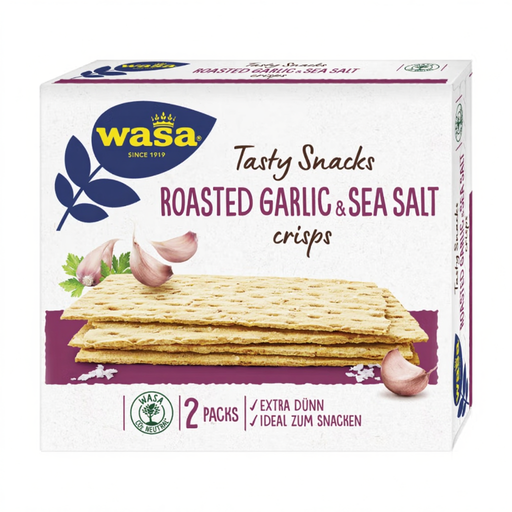
Wasa Round Crispbread Roasted Garlic & Sea Salt, 190 g

Wasa Round Crispbread Roasted Garlic & Sea Salt, 190 g

A seasoned variety for shoppers looking for crispbread with roasted garlic and sea salt, rather than plain wholegrain rye crispbread.

The product name gives the pack size as 190 g. Compare fibre, ingredients and allergens using the information on the specific pack.

View on Joybuy

Frequently asked questions

Is wholegrain rye crispbread automatically easy to digest?

No. You can’t tell how well you’ll personally tolerate it from the wholegrain rye recipe or fibre content alone. Compare the nutrition information and ingredients on the pack, and take your dietary needs into account.

Is rye crispbread gluten-free?

No. Rye is a gluten-containing cereal, as explained by the Federal Office of Consumer Protection and Food Safety. Crispbread made with wholegrain rye flour is therefore not suitable for a gluten-free diet; if needed, look for alternatives explicitly labelled gluten-free.

What should I check on the pack if I have allergies?

Check the ingredients list, any declared allergens and possible ‘may contain’ statements for the specific product. The Federal Office of Consumer Protection and Food Safety lists gluten-containing cereals, milk, soya, tree nuts and sesame, among others, as allergens that must be declared.

How should I store crispbread once it’s opened?

Follow the storage instructions on the relevant pack and keep crispbread dry. The Wasa and Burger varieties listed by REWE specify storage in a dry place; instructions may differ for other products.

Are online nutrition details enough for own-label products?

When buying, also check the nutrition information on the pack. ALDI SÜD notes that different suppliers may mean differences in the nutrition information for GOLDÄHREN wholegrain crispbread; EDEKA says that details may differ between the product page and the packaging.
