
Ceramic Pan Buying Guide: Avoid 3 Common Buying Mistakes
For many health-conscious households, the search for a new frying pan leads to the ceramic pan. It's seen as the modern alternative to the classic Teflon-free pan. However, the market is crowded, and not every product lives up to its advertising claims. Before you make a decision, it's crucial to know the typical pitfalls, which often only become apparent after a few weeks of use.
As your Joybuy Product Recommendation Officer, I'm here to help you make a smart choice. We'll look at the three most common problems that lead to a poor purchase and what you should look for instead.
- The Illusion of Permanent Scratch Resistance: Many pans are advertised as being an extremely scratch-resistant pan. In reality, basic ceramic coatings often lose their non-stick properties after just a few months, as soon as the first micro-scratches appear from everyday use.
- The "PFAS-Free" Misconception: A PFAS-free pan is an important criterion. But this label alone doesn't guarantee a completely healthy pan. To be certain, ensure a product is also explicitly declared as PFOA-free, PTFE-free, lead-free, and cadmium-free.
- The Warped Pan Base: A budget ceramic frying pan often has a base that is too thin and made of aluminium. This can warp at high temperatures, leading to uneven heat distribution. On ceramic or induction hobs, the pan no longer lies flat and becomes practically useless.
What Really Matters in a Ceramic Pan
To avoid these problems, you should carefully examine three key technical features. These determine the durability, safety, and performance of your new pan.
1. Ceramic Coating Construction
A high-quality ceramic coating is more than just a thin, coloured layer. It is applied using a complex sol-gel process. Look for products that feature a multi-layer coating, often reinforced with particles like titanium or diamond. This structure provides significantly higher abrasion resistance and preserves the non-stick properties for longer. A simple, single-layer coating is more susceptible to rapid wear and tear.
2. Pan Base Construction and Hob Compatibility
The base is the foundation of the pan. A thick, warp-resistant base made from a multi-ply material (often a combination of stainless steel and aluminium) ensures fast and, most importantly, even heat distribution. This prevents food from burning in hot spots. If you own an induction hob, compatibility as a pan for induction is essential. The pan base must contain a ferromagnetic layer for this to work. This is usually indicated by a coil symbol or an explicit label.
3. Oven Safety and Handles
A pan's versatility is also reflected in its heat resistance. A pan that is oven-safe significantly expands your cooking options—for example, for finishing dishes or keeping food warm. Check the maximum temperature resistance of both the pan body and the handle. Detachable handles often offer the greatest flexibility and also facilitate space-saving storage.
Top Picks for Every Need
Based on these objective criteria, we have identified several products that offer a suitable solution for different user profiles.
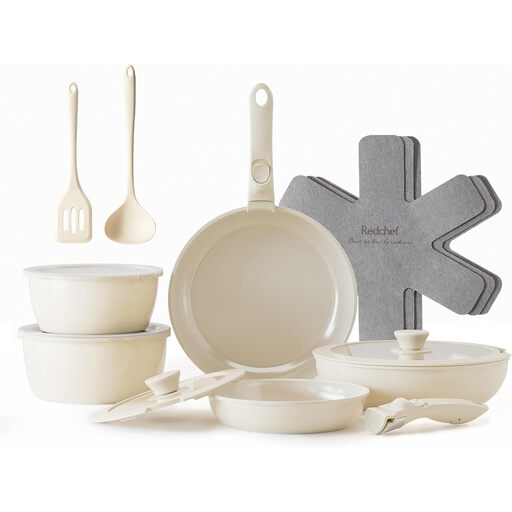
Redchef 16-Piece Ceramic Cookware Set with Detachable Handle
Why This Fits Their Persona: Ideal for small kitchens, RVs, or anyone who values maximum flexibility and organisation. The set covers almost all cooking needs and can be stacked to save an incredible amount of space.
The detachable handles allow for unrestricted oven use (up to 450°C / 840°F) and solve the problem of non-heat-resistant handles. The stackable design is a clever solution for limited space.
Versatility: Go from the hob directly to the oven, fridge, or table. Space-Saving: According to the manufacturer, it uses up to 75% less cupboard space.
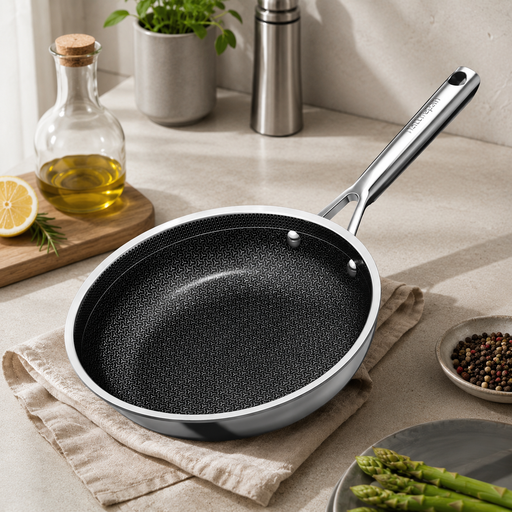
naturepan Hybrid Ceramic Frying Pan 28cm
Why This Fits Their Persona: For cooks who demand high performance and durability. This pan is designed for intensive use and combines the benefits of stainless steel and ceramic.
The 5-layer hybrid construction with a stainless steel core counteracts base warping. The laser-etched honeycomb pattern protects the ceramic coating in the recesses, directly addressing the problem of poor scratch resistance.
Robust Construction: 5-layer build and a diamond-titanium coating for high durability. Even Heat: The tri-ply stainless steel core provides excellent heat conduction and retention.
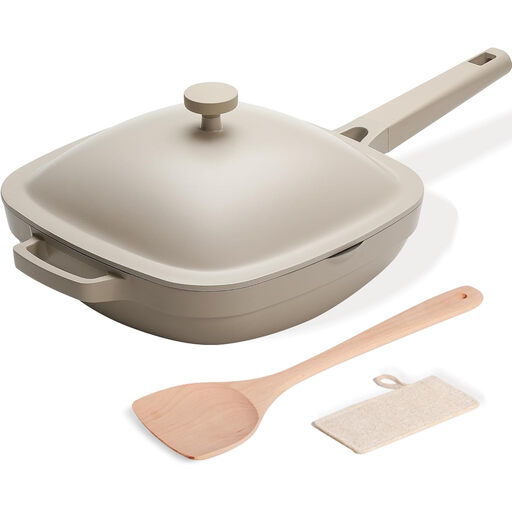
USELUCK 10.5 Inch (3.8QT) Ceramic Pan with Lid
Why This Fits Their Persona: A straightforward and versatile entry-level model for those whose main focus is a verifiably non-toxic coating and ease of use.
This product is explicitly advertised as PFAS-free and non-toxic, directly addressing concerns about hidden chemicals. The die-cast aluminium body is lightweight yet warp-resistant.
Health & Safety: The Ti-Ceramic coating is free of PFAS and other harmful substances. Practical Design: The high sides and included lid make it ideal for braises and sauces.
Looking for More Options?
We have compiled a complete, up-to-date list of products that fully meet these strict selection criteria and safety regulations.
Frequently Asked Questions
How long does a ceramic pan really last?
The lifespan of a ceramic pan depends heavily on the quality of the coating and proper care. High-quality, multi-layer pans can last for several years with correct use. Avoid metal utensils, extreme thermal shock (e.g., putting a hot pan under cold water), and preferably clean the pan by hand with a soft sponge.
Do you need to use oil in a ceramic pan?
Yes, using a small amount of oil or fat is recommended. Although ceramic pans have excellent non-stick properties, a thin layer of fat protects the coating from overheating, improves searing results, and can extend the pan's lifespan.
How can I tell if a ceramic pan is suitable for induction?
Look for the term "induction-compatible" or the coil symbol (a stylised spiral) in the product description. A simple practical test: hold a magnet to the bottom of the pan. If the magnet sticks, the pan is suitable for an induction hob.