
Cast Aluminum Cookware Buyer's Guide for Home Kitchens
The search for the right cookware can quickly become overwhelming. Especially with cast aluminum cookware, many manufacturers promise features that don't always hold up in practice. A new cast aluminum pan or cast aluminum pot that becomes unusable after just a few months is not only frustrating but also a poor investment. Before you make a decision, it's crucial to understand the common pitfalls often hidden behind appealing marketing.
Three common problems lead to disappointment:
- Uneven Heat Distribution: The pan has “hot spots” where food burns, while it remains raw in other areas. This is often a sign of low-quality material or a construction that is too thin.
- Rapidly Deteriorating Non-stick Coating: The advertised non-stick pan loses its properties after a short time. Scratches appear even with careful use, and cleaning becomes increasingly difficult.
- Incorrect Induction Compatibility Claims: A pan purchased as induction-compatible performs poorly or not at all on an induction hob because the base is not optimally designed.
This guide will show you which technical features to look for to make an informed purchasing decision and find durable, functional cookware.
What Really Matters in Your Selection: The Core Parameters
To avoid the problems mentioned above, you should examine three crucial technical aspects. These define the quality and longevity of cast aluminum cookware.
1. Material and Manufacturing Process: Forged Aluminum
The term "cast aluminum" can be misleading. High-quality cookware is often not cast but made from forged aluminum. In this process, the aluminum is pressed into shape under high pressure. The result is a denser material structure compared to simple cast aluminum.
- Advantage: A denser structure conducts heat faster and, most importantly, more evenly from the base to the rim. This prevents heat buildup and ensures uniform cooking results. Look for terms like "geschmiedetes Aluminium" or "forged aluminum" in the product description.
2. Base Construction and Induction Compatibility
Functionality on modern hobs depends entirely on the construction of the base. For a frying pan to be induction-compatible, it needs a ferromagnetic base plate, usually made of stainless steel.
- Key Features:
- Base Thickness: A thicker base (e.g., 3 mm or more) is more dimensionally stable and less prone to warping at high temperatures. A flat, stable base is essential for efficient heat transfer on all hob types, especially ceramic and induction.
- Full-Surface Induction Plate: For induction cookware, the stainless steel plate should cover the entire base diameter if possible. Perforated or "dotted" plates can impair energy transfer and cause a buzzing noise. Check the specifications for cookware for all hob types.
3. Type and Quality of the Non-stick Coating
A non-stick pan is convenient, but the differences in durability are enormous. Longevity depends on the number of layers and the material applied.
- Multi-Layer Systems: Coatings with two or three layers are more resistant to abrasion and scratches than simple single-layer systems. PTFE (Polytetrafluoroethylene) is commonly used and is considered safe when used correctly.
- Follow Care Instructions: Even the most robust coating benefits from proper care. Using wooden or silicone utensils and washing by hand are often recommended to significantly extend its lifespan. Check if the manufacturer restricts dishwasher use.
Guide by User Profile
Based on the criteria above, we have identified several products suited for specific user profiles and their needs.
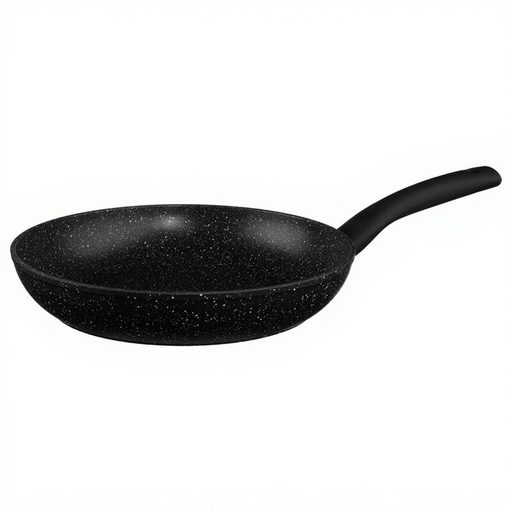
5five Minimalist Smart - Caractère Forged Aluminum Frying Pan 28cm
Why This Fits Their Persona: Ideal for those who need a reliable and versatile pan for daily meal preparation. The 28 cm diameter offers ample space for most dishes, from fried eggs to sautéed vegetables or meat.
The forged aluminum body and stainless steel induction base ensure even heat distribution, preventing inconsistent cooking. The robust non-stick coating is designed for longevity.
Suitable for all hob types, including induction. The ergonomic handle ensures safe handling.
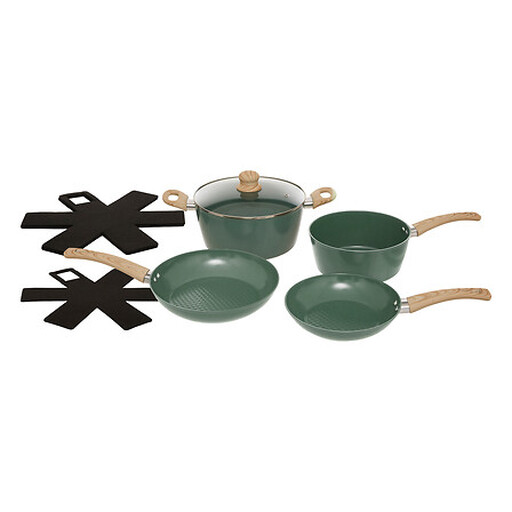
7-Piece Forged Aluminum Cookware Set
Why This Fits Their Persona: Perfect for beginner cooks or as a starter kit. This set covers the basic requirements for a wide range of dishes with various pans and pots, from frying and boiling to simmering.
Provides consistent material quality (forged aluminum) across all pieces. Instead of buying individual, potentially incompatible items, you get a coordinated induction cookware set.
Comprehensive set with frying pans and a pot with a lid. The glass lids allow for easy monitoring of the cooking process.
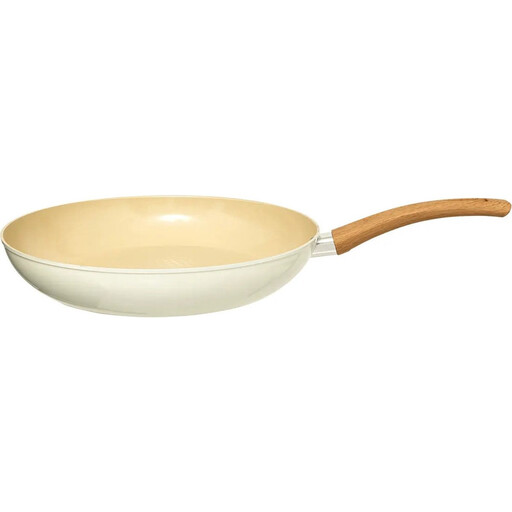
5five Harmony Forged Aluminum Pan - 30 cm, Beige
Why This Fits Their Persona: For buyers who value sustainability without compromising on functionality. This pan combines more eco-friendly materials with modern kitchen technology.
This model proves that recycled aluminum cookware can be high-performing. It features a dual-layer non-stick coating for high scratch resistance and is suitable for all hob types.
The body is made from recycled aluminum. The large 30 cm diameter and high 5.6-liter capacity make it highly versatile.
Looking for More Options?
We have compiled a complete, up-to-date list of products that fully meet these strict selection criteria and German safety regulations.
Frequently Asked Questions (FAQ)
How do I properly care for a cast aluminum pan to protect the coating?
To maximize the lifespan of the non-stick coating, a few basic rules should be followed. Avoid using metal kitchen utensils; instead, opt for tools made of wood, silicone, or plastic. Clean the pan or pot by hand with a soft sponge and mild dish soap, even if the manufacturer states it is dishwasher-safe. Allow the cookware to cool completely after use before exposing it to cold water to prevent thermal shock and warping of the base.
Is all cast aluminum cookware induction-compatible?
No. Induction compatibility is a specific feature that depends on a ferromagnetic plate integrated into the base. Pure aluminum is not magnetic and therefore does not work on an induction hob. Before purchasing, always check the product description or packaging for the official induction symbol (a stylized coil) or the explicit note "suitable for all hob types, including induction."
What is the difference between cast aluminum and cast iron?
Although both materials are popular in the kitchen, they are fundamentally different. Cast aluminum (especially forged aluminum) is significantly lighter, heats up faster, and typically comes with a factory-applied non-stick coating. Cast iron is much heavier, retains heat for a very long time, but requires careful seasoning to develop a natural non-stick surface (patina). Cast aluminum is often more practical for quick, daily use, while cast iron is prized for braising and searing at very high temperatures.