
Car Jack Buyer's Guide 2026: Making the Right Choice for Your Vehicle
A car jack is an essential tool for vehicle owners and workshops. Its primary function is to safely lift a vehicle to allow for tasks such as a tyre change or maintenance work on the underbody. The selection of the right model depends on specific technical requirements, including the vehicle's weight, the required lifting height, and the intended use. A poor choice can not only be inefficient but also a safety hazard. This guide analyses the technical parameters to consider when choosing a car jack.
Buyer's Guide: Technical Criteria for Selection
The decision to buy a car jack should be based on an objective analysis of its specifications. The following parameters are crucial for making an informed choice.
1. Lifting Capacity (Load Capacity)
The maximum lifting capacity, often specified in tonnes (t), is the most important criterion. It must safely exceed the weight of the vehicle to be lifted.
- For standard passenger cars: A jack with a lifting capacity of 1.5 to 2 tonnes is generally sufficient.
- For SUVs, vans, and heavy saloons: A higher lifting capacity is required here. Models with 3t or 5t capacity provide the necessary safety margin. It should be noted that the jack never supports the entire weight of the vehicle, but only a portion of it. Nevertheless, an adequate reserve is essential for stability and safety.
2. Jack Types and How They Work
The mechanism of the jack determines its handling, speed, and range of application.
- Hydraulic Jack: These models use the principle of fluid dynamics. Pumping motions force oil into a cylinder, which raises the lifting arm. A floor jack is a mobile version on castors, characterised by easy positioning and high stability. It is particularly suitable for regular use in workshops or garages.
- Scissor Jack: This model operates with a mechanical leadscrew. Turning the screw causes the scissor-like arms to expand, lifting the vehicle. They are often compact and lightweight but typically require more manual effort than hydraulic systems.
- Electric Jack: This variant is powered via the vehicle's 12-volt socket (cigarette lighter). An electric motor drives the lifting mechanism, allowing the vehicle to be raised without physical exertion. Many models are available as a complete tyre changing kit with additional tools.
- Pneumatic Jack: Also known as an airbag jack, this system uses compressed air from a compressor to inflate one or more airbags, lifting the vehicle quickly. These are designed especially for professional and time-sensitive applications.
3. Lifting Height and Minimum Clearance
The lifting height defines the maximum height to which the vehicle can be raised. The minimum clearance (or minimum height) is the space the jack needs to fit under the vehicle.
- Low-profile jack: For lowered vehicles or sports cars, a model with a very low minimum clearance of under 100 mm is necessary.
- Jacks for SUVs: SUVs and off-road vehicles have greater ground clearance and require a correspondingly high maximum lifting height to get the wheel clear of the ground. Values over 450 mm are often practical here.
4. Material and Build Quality
The durability and safety of a jack depend heavily on the materials used. Most models are made of robust steel. Some floor jacks combine a steel frame with aluminium components to reduce overall weight and improve mobility without compromising stability.
Our Top Jack Picks for 2026
Based on the technical criteria mentioned above, here are some models that are well-suited for different applications due to their specific features.
VEVOR 3T Pneumatic Jack
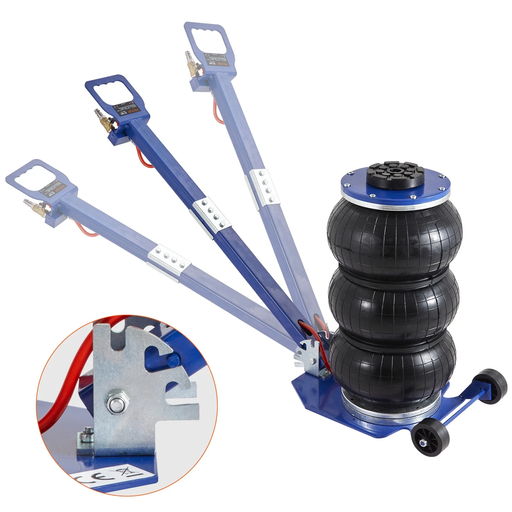
- Why we recommend this product: This model is designed for maximum efficiency. By connecting it to an air compressor, it lifts a vehicle in seconds, according to the manufacturer. This significantly reduces the workload compared to manual systems and is ideal for repetitive lifting tasks.
- Advantages:
- Lifting Capacity: 3 tonnes (6,600 lbs), suitable for cars, pick-ups, and most SUVs.
- Lifting Range: 140 mm to 450 mm, covering a wide variety of vehicles.
- Speed: Very fast lifting process when connected to a compressor.
- Construction: Robust airbag design for demanding use.
- Who it's for: Users with access to a compressed air compressor, such as DIY enthusiasts with a well-equipped workshop or small auto shops that value speed and minimal manual effort.
VEVOR 5T Electric Car Jack
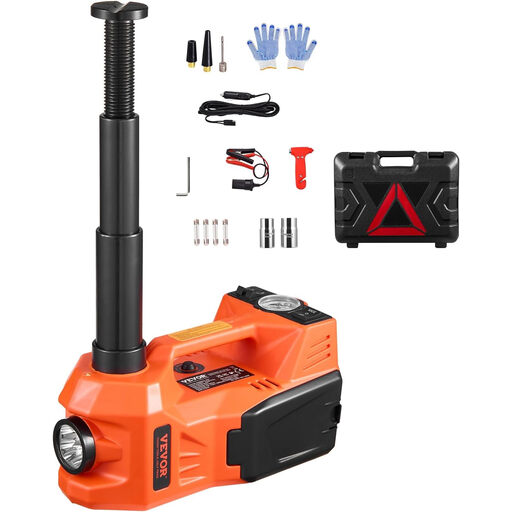
- Why we recommend this product: This product is more than just a jack; it's a multifunctional tyre changing kit for mobile use. The combination of an electric jack, integrated tyre pump, and safety tools makes it a comprehensive solution for roadside emergencies.
- Advantages:
- Lifting Capacity: 5 tonnes, sufficient for heavy SUVs and trucks.
- Multifunctionality: Integrated air pump for inflating tyres.
- Convenience: Operates via the vehicle's 12V socket, lifting at the push of a button.
- Safety Features: Non-slip cross-groove head, LED light for night-time use, and an emergency hammer.
- Who it's for: Private car owners looking for a convenient and complete emergency kit for the road. Especially practical for drivers of heavy vehicles like SUVs who want to avoid the manual effort of a mechanical jack.
LARBANKE 3T Low-Profile Hydraulic Floor Jack
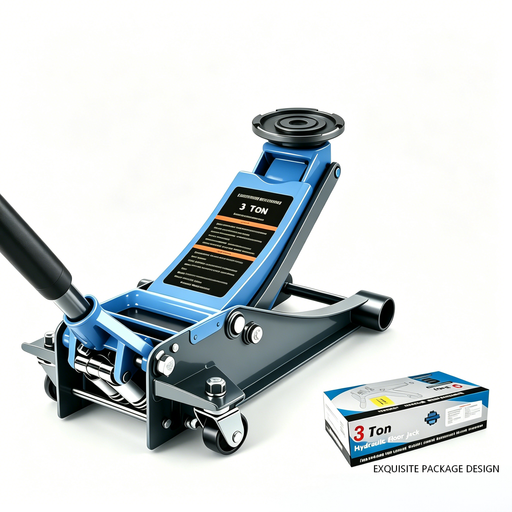
- Why we recommend this product: This hydraulic jack combines a high lifting capacity with a very low minimum clearance, making it extremely versatile. The dual-pump system enables a quick lift, while the hybrid steel and aluminium construction provides a good balance of stability and weight.
- Advantages:
- Lifting Capacity: 3 tonnes (6,600 lbs).
- Low Profile: Very low minimum clearance of approx. 80 mm (3.15 inches), ideal for lowered vehicles.
- Lifting Range: 80 mm to 465 mm (3.15 to 18.31 inches), covering both low sports cars and taller vehicles.
- Quick Lift: Dual-pump system for accelerated lifting.
- Vehicle Protection: A rubber pad and a padded pump handle protect the paintwork.
- Who it's for: DIY auto mechanics and owners of vehicles with low ground clearance. A classic floor jack that should be in every garage where flexibility and speed are required.
Looking for a Different Solution?
Not every problem requires heavy equipment. Sometimes it's the small repairs that make daily life easier. For example, if your work clothes get a tear during maintenance, you can find suitable solutions like Jacket Repair Patches for a quick fix.
Frequently Asked Questions (FAQ)
1. What lifting capacity does a jack need for my car? To determine the required lifting capacity, check your vehicle's gross vehicle weight in its registration documents. Choose a jack with a capacity of at least 75% of this weight. For a 2-tonne car, a 3t jack is a safe choice as it offers a sufficient margin.
2. What is the difference between a floor jack and a scissor jack? A floor jack is a hydraulic device on wheels, known for its high stability, great lifting power, and ease of use. It is ideal for use in the garage. A scissor jack is a mechanical, often very compact device operated by a leadscrew. It requires more physical effort but is lighter and more space-efficient.