
Ambient Car Lighting: Buyer's Guide and Recommendations for 2026
Ambient car lighting provides subtle, indirect illumination for a vehicle's interior. Unlike functional reading or dome lights, its purpose is to create a specific atmosphere, accentuate contours, and enhance the perceived quality of the cabin. Technically, modern systems are based on LED technology, often paired with acrylic or fiber optic light guides to ensure even, glare-free light distribution. Control is typically managed by a central unit operated via an app, remote control, or physical button.
Buyer's Guide: Technical Criteria for Selection
Choosing an aftermarket kit should be based on an analysis of its technical parameters. The following aspects are key to making the right selection.
Technology and Light Distribution: LED vs. Fiber Optics
The method of light generation and distribution is a fundamental differentiator.
- Direct LED Strips: Here, the LEDs are mounted directly onto a flexible strip. They are well-suited for illuminating footwells or under seats, but if directly visible, they can appear as individual points of light.
- Fiber Optics (Light Guides): With this method, light from one or more LEDs is fed into a transparent strand (often made of acrylic). The result is a seamless, continuous interior car light strip, ideal for installation in the gaps of dashboards and door panels. Acrylic light guides often provide greater brightness and more uniform illumination compared to traditional fiber optics.
Control Options: App, Remote, or Button
How you operate the system significantly impacts the user experience.
- Car Interior Lighting with App Control: Control via a smartphone app (usually over Bluetooth) offers the most extensive feature set. You can select precise colours from an RGB spectrum, adjust the brightness and speed of effects, and set timers.
- RF Remote Control: A radio frequency remote allows you to manage basic functions like colour selection, mode changes, and brightness adjustments without a smartphone.
- Buttons: Some systems include physical buttons that can be discreetly placed in the cabin for quick colour changes or to turn the system on and off.
Feature Set: RGB, Dreamcolor, and Music Sync
Modern systems offer more than just static colours.
- Standard RGB: Allows you to select a single colour for the entire system.
- RGB-IC (Dreamcolor): So-called "Smart ICs" (Integrated Circuits) enable individual control over separate segments of an LED strip. This allows for dynamic effects like colour gradients, chasing lights, or "rainbow" animations.
- Sound-Activated Car Lighting: A microphone integrated into the control unit detects ambient sounds or music. The lighting reacts by pulsing or changing colours in time with the beat.
Installation and Power Supply
The complexity of the retrofit depends on the chosen kit.
- Power Source: Most comprehensive kits connect to the vehicle's 12V electrical system. Simpler systems, often designed for the dashboard, use a USB or Type-C connection.
- Modularity: Kits consist of a main controller and often several sub-controllers. This allows for flexible wiring, where, for example, door lights can be connected to their own controller that syncs with the main unit.
- DIY Factor: Retrofitting ambient car lighting typically requires running wires and fitting the light guides into the gaps of the interior trim. Tools like a pry tool are often included in the kit.
Our Selection of Aftermarket Kits
Based on technical specifications and intended use cases, we present three different systems here.
Dreamcolor Acrylic Interior Car LED Strip Light, RGB 22 in 1
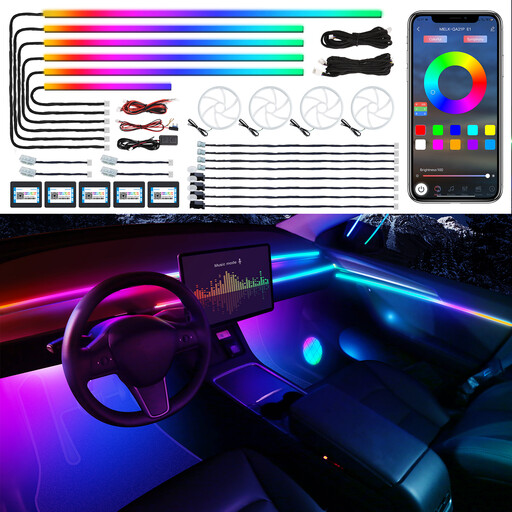
- Why We Recommend It: This kit is designed for maximum coverage of the vehicle's interior. With 22 individual components, including light strips for the dashboard and doors, footwell lights, and lights for door handles, storage bins, and speakers, it enables complete and synchronised illumination. The dual-zone control is a standout feature, allowing for separate configuration of different areas.
- Advantages:
- Comprehensive set for a complete interior design.
- Dual-zone control for displaying different colours/modes simultaneously.
- Bright and uniform illumination via acrylic light guides.
- Control via app ("LotusLamp X") and a hidden touch button.
- Best For: Vehicle owners looking for a comprehensive, integrated lighting solution for the entire interior and who are prepared to undertake a correspondingly extensive installation.
Acrylic Interior Car LED Strip Light with Wireless APP, RGB Dreamcolor 5 in 1
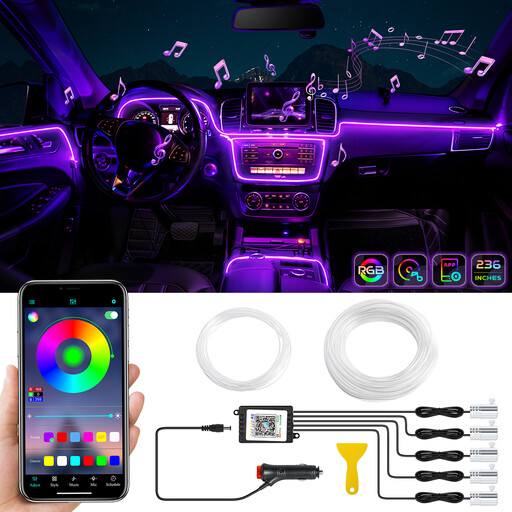
- Why We Recommend It: The strength of this 5-in-1 kit lies in its flexibility. It includes a very long, 6-meter roll of fiber optic that can be cut to size by the user. This allows for a high degree of customisation for individual vehicle interiors and creative layouts not possible with standard kits.
- Advantages:
- Long, cuttable fiber optic roll (6 meters) for maximum DIY freedom.
- 5 LED sources for flexibly connecting the cut segments.
- Control via app ("Lotus Lantern") with 29 preset modes.
- Sound-reactive function for syncing with music.
- Best For: DIY enthusiasts who prefer a custom car RGB LED strip solution and want to completely define the lighting layout themselves.
Dreamcolor Acrylic Interior Car LED Strip Light with USB/Type C, RGB 2 in 1
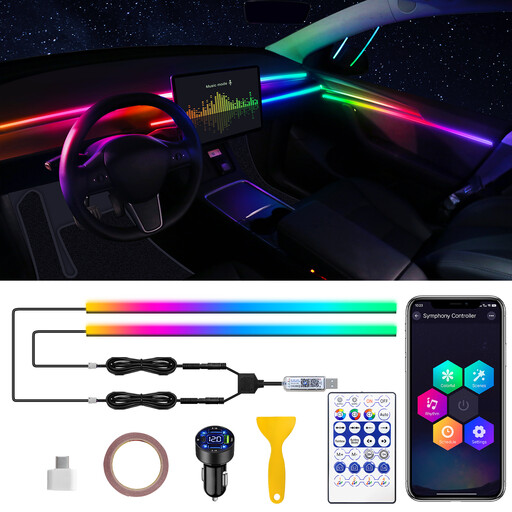
- Why We Recommend It: This 2-in-1 kit focuses on simple installation and power. By connecting via USB or Type-C, it eliminates the need to tap into the vehicle's 12V electrical system. It offers three different control methods (app, remote, button), making it suitable for a quick and straightforward upgrade to the dashboard area.
- Advantages:
- Simple power supply via USB/Type-C (Plug-and-Play).
- Three control modes: App ("ZENGGE"), RF remote, and touch button.
- Focused on dashboard illumination.
- Integrated music sync.
- Best For: Users looking for a simple, quick-to-install solution primarily for the dashboard, who want to avoid complex wiring.
Discover More Options
The products featured here represent a selection covering different needs. For a broader spectrum of solutions tailored to various vehicle models and preferences, you can browse our entire range.
Discover more options in our Ambient Car Lighting category.
Frequently Asked Questions (FAQ)
1. How do you retrofit ambient lighting in a car? Retrofitting is typically done by inserting fiber optics or attaching LED strips into the gaps of the dashboard, center console, and door panels. The control unit is connected to a power source (12V fuse box or USB port). The cables are then concealed behind the trim panels.
2. Can LED interior lighting drain the car battery? Modern car LED interior lighting systems have very low power consumption. When connected to a switched power source (ignition-switched), which only supplies power when the engine is running or the ignition is on, there is no risk of draining the battery. Many kits also feature low-voltage protection. If connected to a constant power source, the lighting should be turned off manually or via the app when not in use.
3. What is the difference between RGB and RGB-IC (Dreamcolor)? In a standard RGB system, all LEDs on the strip light up in the same, simultaneously selected colour. With RGB-IC (also known as Dreamcolor or Magic Color), each LED or a small segment of LEDs can be controlled individually. This enables dynamic effects such as colour gradients, chasing light animations, and multi-colour patterns on a single strip.