
Ceramic Coated Induction Cookware Buying Guide
A new ceramic pan for induction promises healthy, low-fat cooking and easy cleanup. However, the market is flooded with products whose marketing claims often fall short in practice. Many buyers find that after just a few months, the non-stick performance fades or the pan heats unevenly on their induction hob.
As your Joybuy Product Recommendation Officer, I'm here to separate fact from marketing fiction. In this guide, I'll reveal the three most common pitfalls when buying a ceramic pan and highlight the key technical features you should look for to find a durable, high-performance induction frying pan.
The 3 Most Common Traps When Buying a Ceramic Pan
Before you make a decision, you should be aware of the typical issues that can lead to disappointment.
- The "Pure Ceramic" Illusion: The term "ceramic pan" is misleading. It almost always refers to a metal pan (usually aluminium or stainless steel) with a paper-thin ceramic coating. The quality and durability of this layer vary enormously. Budget models often lose their non-stick properties after only a short period of daily use.
- "Induction-Compatible" Is Not "Induction-Optimised": Many pans feature the induction symbol but only have a thin, bonded ferromagnetic base. The result: the pan heats up slowly and unevenly, creating "hot spots" where food burns while other areas barely get warm. This leads to frustrating cooking results and wasted energy.
- Unrealistic Durability Expectations: A ceramic coating is inherently more brittle than a PTFE coating (known by brand names like Teflon). Improper handling—such as using metal utensils, excessive heat, or cleaning a hot pan with cold water—can cause micro-cracks and drastically shorten its lifespan.
What Really Matters: The Key Features of a Good Ceramic Induction Pan
To avoid these traps, focus on the following three technical parameters. They are crucial for performance and longevity.
The Pan Base: The Foundation for Induction
For efficient use on an induction hob, the base construction is critical. Look for a fully ferromagnetic base. Ideally, this should be a thick, multi-ply "sandwich" base. Such a design ensures fast and, most importantly, perfectly even heat distribution across the entire cooking surface. This is the fundamental requirement for controlled cooking without scorching. A solid base also prevents the pan from warping at high temperatures.
The Coating: More Than Just "Ceramic"
A high-quality ceramic coated pan is based on the sol-gel process and is, by standard, PFOA-free and free of other per- and polyfluoroalkyl substances (PFAS). The difference lies in the manufacturing and composition:
- Multi-Layer Coatings: Models with three or more layers are more resistant to abrasion.
- Reinforcement: Some manufacturers reinforce the ceramic matrix with titanium or diamond dust particles. These increase the scratch resistance and durability of the non-stick properties. Such pans are an investment that pays off with frequent use.
Oven Safety and Handles: Details for Greater Flexibility
A pan's versatility is often revealed in the details. A pan declared oven-safe significantly expands your cooking options, allowing you to finish dishes or keep food warm in the oven. Pay attention to the maximum temperature rating and the handle material. Stainless steel handles are typically highly heat-resistant but can get hot on the stovetop. Bakelite handles stay cooler but are often only oven-safe up to about 150–170°C. A practical solution is detachable handles, which offer maximum flexibility between the hob, oven, and table.
Top Recommendations For You
Here are some product recommendations tailored to specific user profiles and the quality criteria mentioned above.
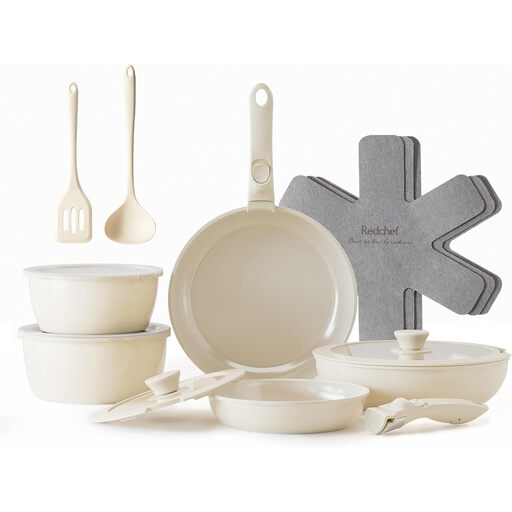
Redchef 16-Piece Ceramic Cookware Set with Detachable Handle
Why This Fits Their Persona: Ideal for families or as a starter kit, this set offers a complete, space-saving, and versatile solution. This induction cookware set covers all the basics, from frying to boiling, and its detachable handles allow for extremely compact storage.
By providing a comprehensive solution, this set prevents the piecemeal purchase of mismatched items. The detachable handles enable true oven-safe use (up to 450°C, according to the manufacturer), and the ceramic coating is explicitly declared PTFE/PFOA-free.
Extremely space-saving, stackable design. Highly versatile, moving seamlessly from the stovetop to the oven, fridge, or directly to the table.
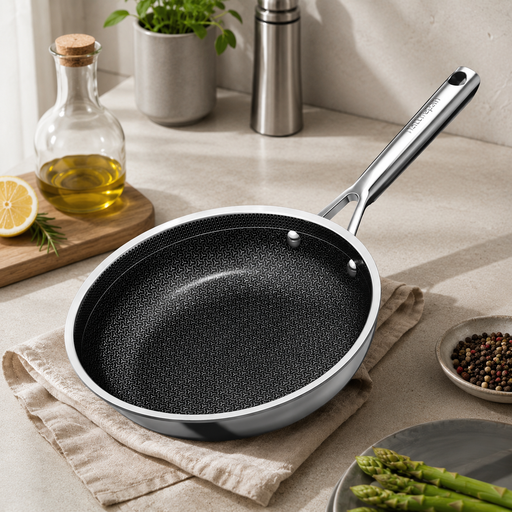
naturepan Hybrid Ceramic Frying Pan 28cm
Why This Fits Their Persona: For cooks who value a precise sear and maximum durability. This pan combines the heat retention of stainless steel with the non-stick properties of a ceramic coating.
It addresses the short lifespan of basic ceramic pans with a 5-layer hybrid construction. The laser-etched hexagonal pattern protects the non-stick coating in the valleys while allowing for a perfect sear on the raised stainless steel ridges.
A combination of high-heat searing and non-stick functionality. The diamond and titanium-reinforced coating offers superior scratch resistance.
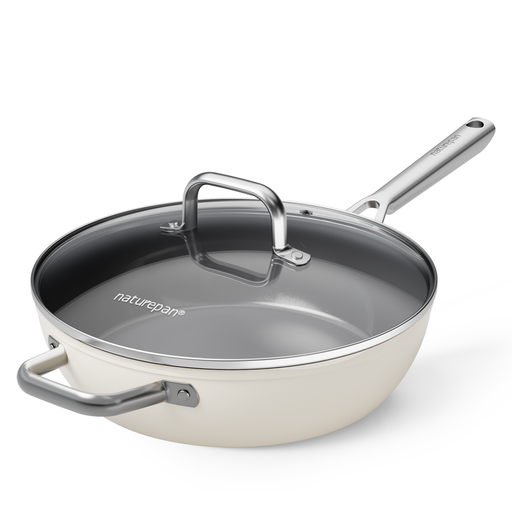
Naturepan Diamond Titanium Ceramic Frying Pan, 28cm, Deep Version with Lid
Why This Fits Their Persona: Perfect for anyone looking for a single pan to handle a wide variety of dishes. The high sides and included lid make it an ideal sauté pan for sauces, curries, or braised meats.
This pan goes beyond the function of a simple frying pan, eliminating the need to buy multiple specialty pans. Its robust, reinforced ceramic coating and oven safety up to 260°C ensure it can withstand demanding cooking methods.
High sides and a matching lid for splatter-free cooking and simmering. The diamond and titanium-reinforced coating promises long-term durability.
Looking for More Options?
We've compiled a complete, up-to-date list of products that fully meet these strict selection criteria and safety regulations.
How long does a ceramic coating really last?
The lifespan of a ceramic coating depends heavily on its quality and how it's cared for. On budget models, the non-stick effect can begin to fade after just a few months. High-quality, multi-layered, and reinforced coatings can last for several years with proper care (no metal utensils, hand washing, avoiding overheating).
Is a ceramic pan for induction always oven-safe?
No, not automatically. Oven safety is determined by the handle material and the manufacturer's specifications. Pans with stainless steel handles are often oven-safe to high temperatures (over 250°C). Models with plastic or Bakelite handles typically have a lower heat resistance (often up to 170°C). Pans with detachable handles offer the most flexibility. Always check the product description for precise temperature ratings.
How do you clean a ceramic pan correctly to preserve its non-stick properties?
Always let the pan cool down completely after use before cleaning it. Submerging a hot pan in cold water can cause thermal shock, which damages the coating. Clean the pan by hand with warm water, a mild dish soap, and a soft sponge or cloth. Avoid abrasive scouring pads or harsh cleaning agents, as they can attack the surface. Even if some pans are declared dishwasher-safe, hand washing is generally recommended to maximise the coating's lifespan.