
Slim Shoe Cabinets: Our 2026 Recommendations
A well-organised entryway makes a functional first impression for any home. In narrow hallways especially, finding a place for shoes can be a challenge. A slim shoe cabinet is designed to use vertical wall space efficiently without taking up valuable walkway width. Models with a depth of under 25 cm are specifically developed for such tight spaces, offering a structured shoe storage solution.
Buyer's Guide: What to Look for in a Narrow Shoe Cabinet
Choosing the right model is based on objective criteria that align with your individual needs and spatial constraints.
1. Dimensions and Space Requirements
The most critical measurement for a hallway shoe cabinet is its depth. Models with a depth of 17 cm to 24 cm are considered particularly space-saving. Measure your intended location precisely, taking into account the opening angle of the tip-out drawers and any existing skirting boards. The height and width determine the furniture's total capacity. Taller models make more efficient use of vertical space, while wider versions can hold more shoes per level.
2. Material and Build Quality
The longevity and stability of a tip-out shoe cabinet depend heavily on the materials used.
- MDF (Medium-Density Fibreboard): This material consists of finely shredded wood fibres pressed together under heat and pressure. It offers high density and a smooth surface, which is ideal for lacquering or foiling. MDF boards compliant with the E1 standard, as defined in EU norm EN 622-1, have low formaldehyde emissions.
- PB (Particle Board): Particle boards are more cost-effective and lighter than MDF. Here too, the E1 standard classification is an indicator of low-emission production. The surfaces are usually coated with melamine resin, making them scratch-resistant and easy to clean.
- Solid Wood and Bamboo: Elements made of solid wood or bamboo can be used for fronts or the main body. Bamboo is a rapidly renewable resource known for its hardness and moisture resistance. Open-pore structures like woven bamboo can promote ventilation inside the cabinet.
3. Capacity and Compartment Layout
Capacity is typically stated in pairs of shoes. A 3-drawer shoe cabinet usually offers space for 9 to 18 pairs, depending on whether the compartments are single or double-row (with a central divider). Check if the dividers are adjustable or removable to accommodate shoes with higher tops or wider designs. Standard tip-out cabinets are primarily designed for low-profile shoes, trainers, and sandals.
4. Assembly and Safety
Due to their shallow depth and significant height, narrow shoe cabinets tend to be top-heavy. Securing the unit to the wall with an anti-tip device is therefore essential for stability and safety. Most manufacturers include the necessary brackets and screws. The maximum load capacity of the individual drawers and the top surface are also relevant technical specifications that should be detailed in the product information.
Our Top Picks for 2026
Based on an analysis of technical specifications and functional design, we present two models that are well-suited for tight spaces.
Caldion 3-Drawer Shoe Cabinet, Grey
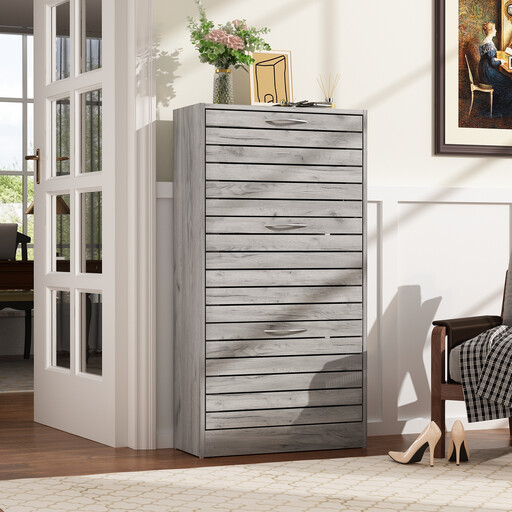
Why we recommend this product This model combines a very small footprint (54 cm wide x 24 cm deep) with a considerable height of 107 cm. Each of the three drawers features a double-row compartment layout, which maximises storage capacity. The design, with horizontal grooves on the fronts and a neutral grey finish, allows for seamless integration into modern interior styles.
Advantages:
- High Capacity: According to the manufacturer, it holds at least 12 pairs of adult shoes thanks to a double-row compartment design.
- Minimal Footprint: At just 24 cm deep and 54 cm wide, it's ideal for very narrow niches or hallways.
- Material: Made from MDF (Engineered Wood), ensuring a stable construction and a smooth finish.
- Design: The clean, modern aesthetic complements many home decor concepts.
Who it's for: Individuals who need to store the maximum number of shoes in a minimal amount of space and prefer a clean, understated design. Especially suitable for narrow entryways in city apartments.
SoBuy Wood-Look Shoe Cabinet with 3 Drawers
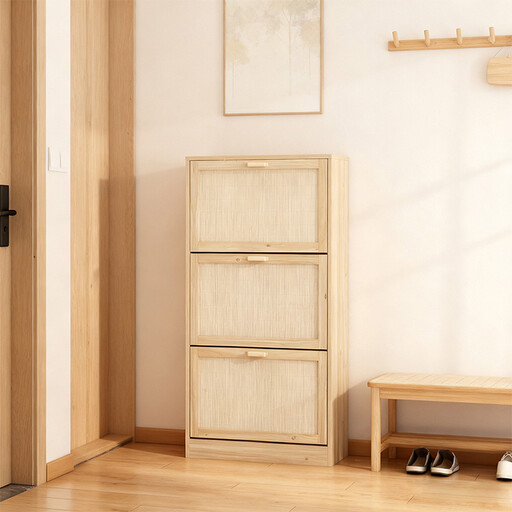
Why we recommend this product This model stands out for its combination of materials. The drawer fronts are made of woven bamboo, which not only creates a natural look but also aids air circulation inside the cabinet. The body is constructed from MDF (E1) and particle board (E1). With a depth of 24 cm, this shoe cabinet is also slim and space-saving. The included anti-tip hardware underscores its focus on safety.
Advantages:
- Functional Material Mix: The woven bamboo on the doors promotes ventilation, which can help prevent odour build-up.
- Low-Emission Materials: The manufacturer states that it uses MDF and particle board compliant with the E1 standard.
- Safety Feature: An anti-tip device for wall mounting is included in the delivery.
- Flexible Organisation: Adjustable shelves behind the three drawers allow for customisation to fit different shoe sizes.
Who it's for: Users who value natural materials and good ventilation for their shoes. The combination of a wood-look finish and bamboo fits well with Scandinavian or nature-inspired interior styles.
Alternatives: For Storing More Than Just Shoes
An enclosed shoe rack in the form of a tip-out cabinet is a specialised solution. If you need to store accessories like scarves, gloves, or keys in addition to shoes, or if you prefer a wider unit, a wooden chest of drawers could be a suitable alternative. These pieces of furniture often offer a combination of drawers and doors and are available in a wide variety of designs and sizes.
Discover our selection of wooden chests of drawers here.
Frequently Asked Questions (FAQ)
1. How deep is a typical slim shoe cabinet? A shoe cabinet described as "slim" generally has a depth between 17 cm and 25 cm. Models around 24 cm deep, like the ones featured here, are common as they offer a good compromise between a small footprint and adequate stability.
2. Can taller shoes like boots fit in a tip-out shoe cabinet? Standard tip-out shoe cabinets are designed for low-profile shoes like trainers, ballet flats, or loafers. Ankle boots or boots usually do not fit due to their shaft height. Some models offer removable dividers, which might allow a pair of ankle boots to be placed sideways in a drawer, but this significantly reduces the total capacity.
3. Does a tip-out shoe cabinet need to be fixed to the wall? Yes, wall mounting is strongly recommended. Due to their design (tall and narrow), shoe cabinets have a high centre of gravity. When you open the drawers, especially the top one, the weight shifts forward. An anti-tip device prevents the furniture from falling over, ensuring safety in the household, particularly where children are present.