
Choosing an SD Card for 4K Video
As a Joybuy Product Recommendation Officer, I often see well-intentioned purchases lead to frustration due to misleading marketing claims. Especially when choosing an SD card for 4K video, the wrong decision can mean the difference between a flawless recording and lost footage. A common problem is a recording that abruptly stops because the memory card can't process the data stream fast enough.
This guide focuses on the objective criteria that truly matter, helping you navigate the technical pitfalls that often lead to bad buys.
The 2 Most Common Traps When Buying a Memory Card
- Focusing on the Big Number: Read Speed vs. Write Speed. Manufacturers prominently advertise high read speeds (e.g., "up to 205 MB/s") because they sound impressive. However, for recording 4K video, the write speed is what's critical. If it's too low, the camera can't save the incoming video data to the card fast enough, resulting in aborted recordings or corrupted files.
- The Symbol Puzzle: Misinterpreting Speed Classes. The packaging is covered in symbols like U3, V30, or Class 10. Many users buy a card that is advertised as "fast" but doesn't offer the guaranteed, sustained write speed required for high-resolution video. The result is visual artifacts (dropped frames) or recording errors, especially during longer 4K clips.
What Really Matters: The Key Parameters for 4K Recording
To ensure your camera memory card can handle the demands of 4K video and high-speed burst photography, you should check three core parameters.
1. Write Speed: The Critical Metric for Recording
Write speed indicates how quickly data can be written to the card. For smooth 4K recording, the card must have a high, sustained write speed. A fast SD card for burst photos in RAW format also benefits directly from this, as the camera's buffer clears more quickly.
- Read Speed: Important for quickly transferring data from the card to a computer.
- Write Speed: Crucial for the recording process itself, especially with data-intensive formats like 4K video.
2. Speed Classes: U3 and V30 as the Minimum Standard
The symbols on the card aren't just for decoration; they are standardized performance guarantees. For 4K video, two classes are particularly important:
- UHS Speed Class 3 (U3): The "U" with a 3 inside guarantees a minimum sustained write speed of 30 MB/s. This is the baseline requirement for most 4K recording.
- Video Speed Class 30 (V30): This newer classification also guarantees a minimum write speed of 30 MB/s and was introduced specifically for high-resolution video formats. A V30 memory card is therefore a safe bet for 4K content.
For professional applications with very high bitrates (e.g., 4K at 120 fps or 8K), cards rated V60 (60 MB/s) or V90 (90 MB/s) are required. However, for most DSLR and mirrorless cameras, V30 is the established standard.
3. Capacity and Format: SDXC for Future-Proofing
Modern memory cards are divided into two main categories:
- SDHC (Secure Digital High Capacity): Capacities from 4 GB to 32 GB.
- SDXC (Secure Digital Extended Capacity): Capacities from 64 GB to 2 TB.
Since a single minute of 4K video can take up several hundred megabytes depending on compression, SDHC cards quickly hit their limits. An SDXC UHS-I U3 card is the practical choice for 4K videographers, as it offers enough space for longer projects and supports the exFAT file system, which is necessary for video files larger than 4 GB.
Top SD Card Choices
Here are some recommendations based on the objective criteria above, tailored for specific user groups.
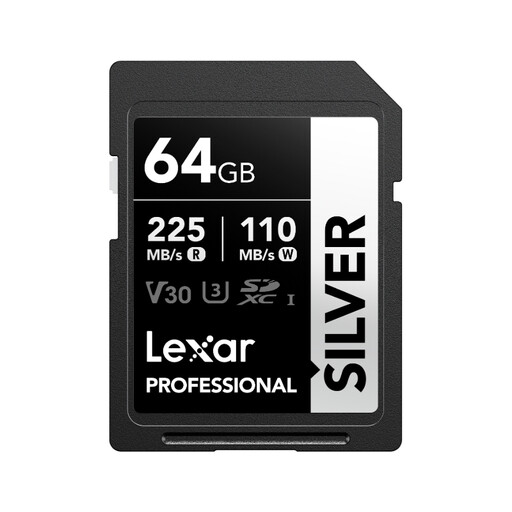
Lexar 64GB SD Card Silver, Up To 205MB/s Read, 90MB/s Write, SDXC UHS-I Memory Card
Why This Fits Their Persona: This card offers a solid balance of price and performance. With 64 GB of capacity and a reliable V30 rating, it's ideal for getting started with 4K videography and for photographers shooting RAW burst photos without a major investment.
It avoids the trap of misleading speed claims because it is clearly certified as V30 and U3. The guaranteed minimum write speed of 30 MB/s ensures that 4K recordings won't stop unexpectedly.
The write speed of up to 90 MB/s is significantly higher than the V30 minimum standard, providing headroom for fast burst shooting. It is compatible with common DSLR and mirrorless cameras.
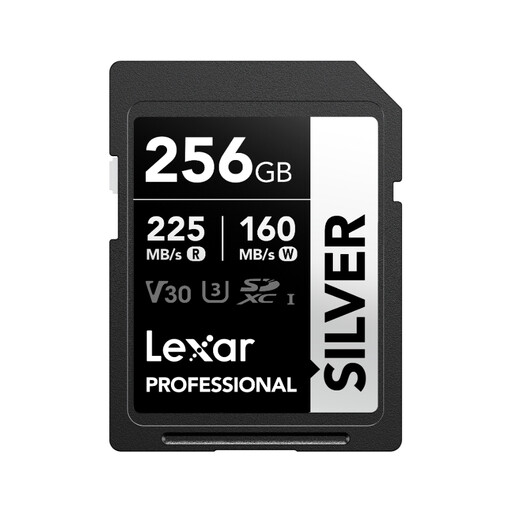
Lexar 256GB SD Card SILVER, Up to 205MB/s Read, 140MB/s Write
Why This Fits Their Persona: For professional users who depend on absolute reliability at events, weddings, or commercial shoots. The high write speed of 140 MB/s and large 256 GB capacity enable long, uninterrupted 4K recordings and rapid RAW burst sequences.
This Lexar SD card far exceeds the minimum requirements for 4K. It offers performance headroom that prevents bottlenecks even with high-bitrate cameras or demanding burst shooting, thus minimizing the risk of data loss.
The maximum write speed of 140 MB/s clears the camera buffer extremely quickly. The 256 GB capacity provides enough space for a full day of shooting without needing to swap cards.
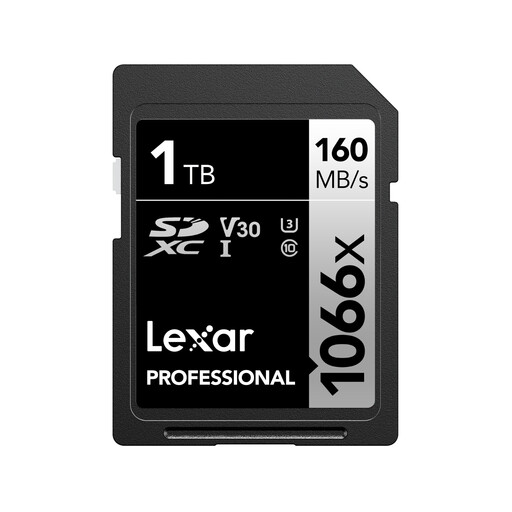
Lexar 1TB Professional 1066x SD Card, UHS-I, C10, U3, V30
Why This Fits Their Persona: For documentary filmmakers, travel vloggers, or event photographers for whom swapping cards is not an option. The massive 1 TB capacity allows for storing many hours of 4K footage or tens of thousands of RAW photos on a single card.
This card solves the capacity problem without compromising on speed. It meets the V30/U3 standard, ensuring that performance remains consistently high and no data is lost, even during long recording sessions.
The 1 TB capacity is the decisive advantage for long-form projects. The write speed of up to 120 MB/s also offers high performance for demanding recording formats and fast burst shooting.
Looking for more options?
We have compiled a complete, up-to-date list of products that fully meet these strict selection criteria.
How many minutes of 4K video fit on a 64 GB card?
The exact duration depends heavily on the bitrate (data rate) your camera uses. As a rough guideline: at a common bitrate of 400 Mbps (equivalent to 50 MB/s), you can record approximately 20 minutes of 4K footage on a 64 GB card. At lower bitrates, the recording time will increase accordingly.
Do I need to format my new SD card in the camera?
Yes, it is highly recommended to always format a new SD card for your DSLR or mirrorless camera directly in the device before its first use. This optimises the card's file system for your specific camera, which increases reliability and helps prevent potential write errors.
What is the difference between an SD card and a microSD card for cameras?
The main difference is their physical size. SD cards are larger and typically used in DSLR and mirrorless cameras. MicroSD cards are significantly smaller and are used in smartphones, drones, and action cameras. Although you can use a microSD card with an adapter in an SD card slot, the adapter introduces an additional potential point of failure. For maximum reliability in professional shoots, it is advisable to use the native card format your camera was designed for.