
Mechanical Keyboard Buying Guide: How to Choose the Right One
The search for a new keyboard leads many users away from conventional membrane models and into the world of mechanical keyboards. The reasons for making the switch are diverse—whether it's for more precise inputs in gaming, a more satisfying feel when typing long texts, or the potential for customisation. However, the market is vast, and the technical jargon can be overwhelming.
This article serves as a guide. We will introduce various concepts and present a selection of models that cater to different needs. Our goal is to provide you with the information you need to make an informed decision, whether you're looking for a gaming keyboard or want to optimise your work setup.
What to Look for When Choosing a Mechanical Keyboard
The choice of a model heavily depends on personal preferences and the intended use case. Three key aspects can help narrow down the selection.
1. The Layout: Form Factor and Footprint
The size of the keyboard directly impacts ergonomics and the available space on your desk. Common formats include:
- Full-Size (100%): The classic layout with all keys, including the numeric keypad. Suitable for users who frequently enter numerical data.
- TKL (Tenkeyless, approx. 80%): A TKL keyboard omits the numpad, creating more space for mouse movement. It's a popular compromise between functionality and compactness.
- 75%: An even more compact layout that moves the arrow keys and some function keys right next to the main key cluster. Efficient and space-saving.
- 60% / 65%: A 60% keyboard reduces the layout to the essential alphanumeric keys. Functions like arrow or F-keys are accessible via a secondary layer (FN key). Ideal for minimalist setups and maximum portability.
2. The Switches: Typing Feel and Customisability
The heart of every mechanical keyboard is the switches beneath each key. They determine the typing feel and acoustics. The three main types are:
- Linear (e.g., Red Switches): A smooth, consistent keystroke from top to bottom with no resistance. Preferred for fast-paced gaming as there is no tactile bump to overcome.
- Tactile (e.g., Brown Switches): A noticeable tactile bump upon actuation that signals a keypress without producing a loud click. An all-rounder for both typing and gaming.
- Clicky (e.g., Blue Switches): Produces a distinct clicking sound in addition to the tactile feedback. Many prolific typists appreciate this audible feedback.
A key feature for enthusiasts is hot-swap capability. A hot-swap keyboard allows you to change the switches without any soldering. This offers maximum flexibility to customise the typing feel or easily replace faulty switches.
3. Additional Features: Connectivity and Materials
Modern keyboards offer a range of other features:
- Connectivity: Besides the classic wired connection, there are wireless mechanical keyboards that communicate with the PC via Bluetooth or 2.4 GHz wireless. This ensures a clutter-free desk.
- Keycaps: Keycaps are typically made of ABS or PBT plastic. PBT keycaps are considered more durable and resistant to wear and the shine that can develop from frequent use.
- Special Features: An RGB keyboard offers customisable lighting effects. A keyboard with a rotary knob can simplify volume control or other functions.
Recommended Mechanical Keyboards
Here, we present three models that are interesting for different user profiles due to their specific features and configurations.
AJAZZ AK820 75% TKL Wired Mechanical Keyboard
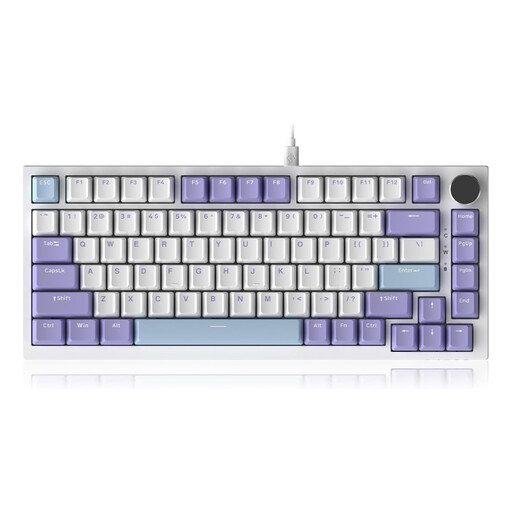
Why it stands out: The AK820 combines a compact 75% layout with high-end features often found in more expensive models. Its gasket-mount structure, where the PCB is cushioned between gaskets, works with multiple dampening layers to create a muted and pleasant typing sound. The CNC-machined rotary knob for volume control is a practical detail for daily use.
Pros:
- Gasket-mount structure for a softer typing feel
- Hot-swap capable for 3-pin and 5-pin switches
- Compact 75% TKL keyboard layout saves space
- Integrated rotary knob for media control
- Durable PBT keycaps in an OEM profile
Who is it for? This model is aimed at users seeking a compact yet fully functional keyboard for gaming and productive work. Those who value a refined typing experience and practical features like a volume knob will find this a suitable option.
MageGee STAR 61 60% Wired Gaming Keyboard
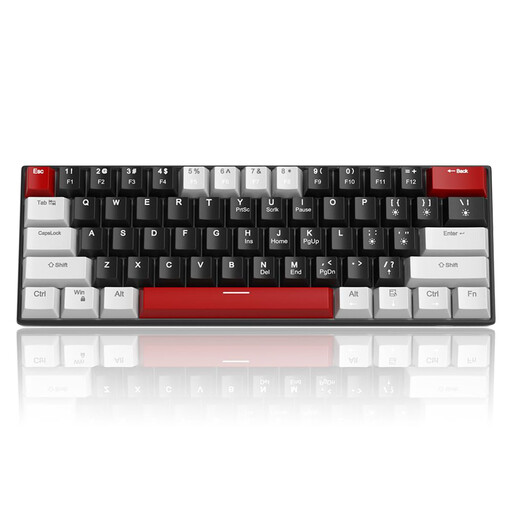
Why it stands out: The MageGee STAR 61 focuses on the essentials: an ultra-compact 60% keyboard layout and reliable performance for gaming and typing. By omitting dedicated arrow and function keys, it achieves maximum desk space savings. These functions remain accessible via FN key combinations.
Pros:
- Extremely compact 60% form factor, ideal for small desks and travel
- Detachable USB-C cable for easy transport
- N-Key Rollover (Anti-Ghosting) ensures all keystrokes are registered
- Available with linear (Red) or clicky (Blue) switches
- Ice-blue LED backlighting with 19 modes
Who is it for? The STAR 61 is a great choice for newcomers to the world of mechanical keyboards, as well as for purists and gamers who prefer a minimalist setup. Its portability and straightforward plug-and-play approach make it a practical companion.
AJAZZ AK980 V2 Wireless Mechanical Keyboard
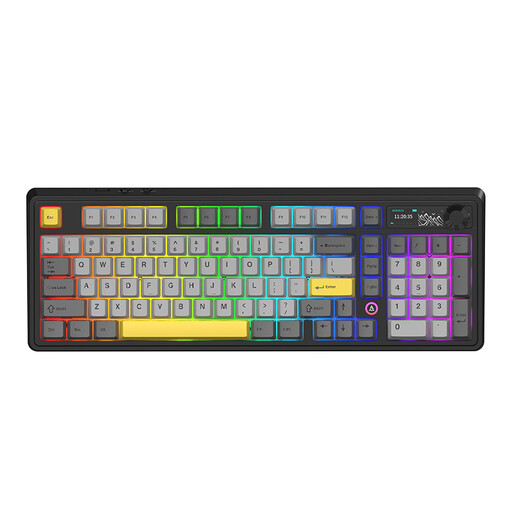
Why it stands out: The AK980 V2 is a powerhouse of functionality and flexibility. As a wireless mechanical keyboard, it offers three connection modes (Bluetooth, 2.4 GHz, wired) and a large 10,000 mAh battery. The highlight is its integrated TFT colour display, which can show system information, connection status, or even custom GIFs, all controlled by the programmable rotary knob.
Pros:
- Tri-mode connectivity (Wired, Bluetooth 5.0, 2.4G Wireless)
- Hot-swap PCB for easy switch customisation
- Innovative TFT display and programmable rotary knob
- Large 10,000 mAh battery for extended wireless use
- High-quality double-shot PBT keycaps and gasket-mount design
Who is it for? This model appeals to power users, tech enthusiasts, and anyone who desires maximum connectivity and customisability. If you need a flexible setup for multiple devices and appreciate innovative features like a status display, the AK980 V2 is a comprehensive solution.
Discover More Options
The models presented here already cover a broad spectrum. However, if you are looking for different layouts, specific switch types, or alternative designs, it's worth taking a look at our extended collection.
? Discover a wider selection in our Gaming USB Keyboard category.
Frequently Asked Questions (FAQ)
What is the advantage of a hot-swap keyboard?
A hot-swap keyboard allows you to change the mechanical switches under the keycaps without tools or soldering. This offers two main advantages: First, you can customise the typing feel and sound of your keyboard at any time by trying out different switch types (e.g., switching from linear to tactile). Second, it simplifies maintenance, as a faulty switch can be easily pulled out and replaced with a new one.
Are mechanical keyboards better for typing?
Whether a mechanical keyboard is "better" depends on personal preference. Many users find the tactile and audible feedback of mechanical switches more satisfying, which can lead to higher perceived typing accuracy. Unlike standard membrane keyboards, the variety of switch types (linear, tactile, clicky) allows for fine-tuning to an individual's typing style.
What does TKL mean on a keyboard?
TKL is an abbreviation for "Tenkeyless." A TKL keyboard is a model that omits the numeric keypad on the right side. This makes the keyboard narrower than a full-size model. This saves desk space and allows for a more ergonomic posture, as the mouse can be positioned closer to the body.