
Electric SUP Pump: Expert Inflation Guide
Manually inflating a Stand Up Paddle Board (SUP) can be a strenuous task that consumes valuable time and energy before you even get on the water. An electric SUP pump automates this process, ensuring your board is quickly and precisely inflated to the correct pressure. This guide will help you understand how these devices work, their essential features, and how to make an informed choice.
What to Look for in an Electric SUP Pump
Choosing the right pump depends on your individual needs. Three key criteria will help you decide.
1. Power Source: Battery Flexibility or 12V Connection Reliability?
The type of power source determines where and how you can use the pump.
- A SUP pump with a battery offers maximum flexibility. You aren't dependent on an external power source and can inflate your board right at the water's edge, even if your vehicle is parked far away. Pay attention to the battery capacity, often specified in watt-hours (Wh), which indicates how many boards can be filled on a single charge.
- A 12V SUP pump connects directly to your vehicle's 12V accessory socket (cigarette lighter). This ensures a constant and reliable power supply as long as the vehicle is within reach. These models are often a more cost-effective option and are ideal if you always drive to your paddle spot anyway.
2. Pressure Performance and Auto-Shutoff
The correct air pressure, typically between 12 and 18 PSI, is crucial for the stability and performance of an inflatable paddle board. A suitable electric air pump for a SUP must be able to reach this high-pressure range. An integrated digital pressure gauge with an auto-shutoff feature is an essential characteristic. You set the target pressure, and the pump stops automatically once it's reached. This prevents potentially damaging over-inflation and ensures safe and precise operation.
3. Inflation Speed and Cooling System
A pump's efficiency is determined by its inflation speed, measured in litres per minute (L/min). Many models, often referred to as SUP compressors, operate with a two-stage system:
- Stage 1: High volume at low pressure to quickly fill the board with air.
- Stage 2: High pressure at lower volume to reach the target pressure.
An active cooling system is particularly important if you plan to inflate multiple boards consecutively. It prevents the device from overheating, thus ensuring a longer lifespan and consistent performance.
Electric Inflatable SUP Pumps
Here, we present a selection of models that cater to different needs.
OutdoorMaster 20PSI Shark2S with Battery
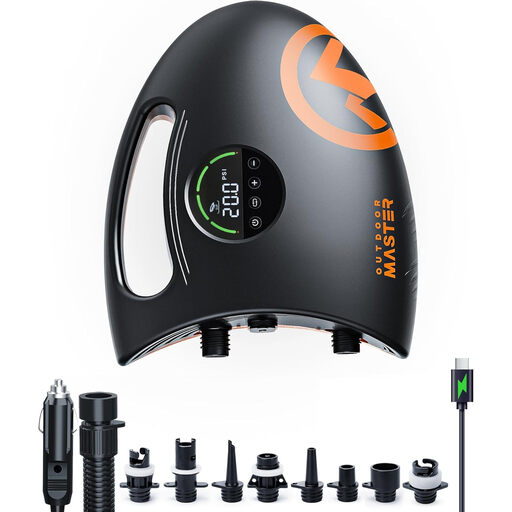
Why It Stands Out The Shark2S combines the power of a high-pressure pump with the independence of an integrated battery. The ability to quickly recharge the device via a Type-C port makes it a modern and versatile companion.
Pros
- Integrated Battery: The 88.8 Wh battery allows for the inflation of up to six SUPs on a single charge (according to manufacturer specifications).
- Flexible Charging Options: Rechargeable via a 45W Type-C port in approx. 2 hours or via the 12V DC connection in your car.
- Additional Function: Can be used as a power bank to charge mobile devices.
- Comprehensive Accessories: Includes 8 different nozzles for high compatibility.
Who Is It For? This model is ideal for paddlers who value independence from a direct power source at the water and often inflate multiple boards for family or friends. The power bank function offers an additional practical benefit during outdoor activities.
OutdoorMaster 20PSI Shark2 with 12V Connection
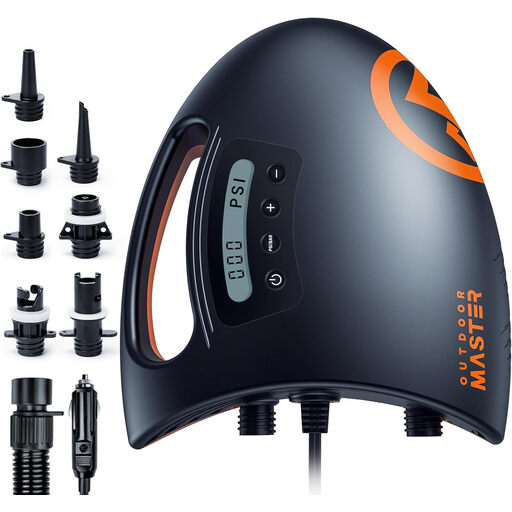
Why It Stands Out The Shark2 is a proven model that focuses on the core functions: reliable inflation via the vehicle's 12V connection. Its active cooling system is designed to deliver consistent performance even during consecutive uses.
Pros
- Active Cooling System: Allows for the continuous inflation of up to three boards without a cooldown break.
- Two-Stage Inflation: A rapid volume phase (350 L/min) and an efficient pressure phase (70 L/min) ensure a swift process.
- Reliable Power Source: Operation via the 12V DC car connection ensures unlimited runtime as long as the vehicle is running.
- Integrated Sand Filter: Protects the motor from contaminants and increases its durability.
Who Is It For? The Shark2 is an excellent choice for users who will always use their pump for their inflatable paddle board near their vehicle. It is a robust and efficient solution for individuals or small groups who value reliability and durability.
OutdoorMaster 20PSI Shark3 with Battery
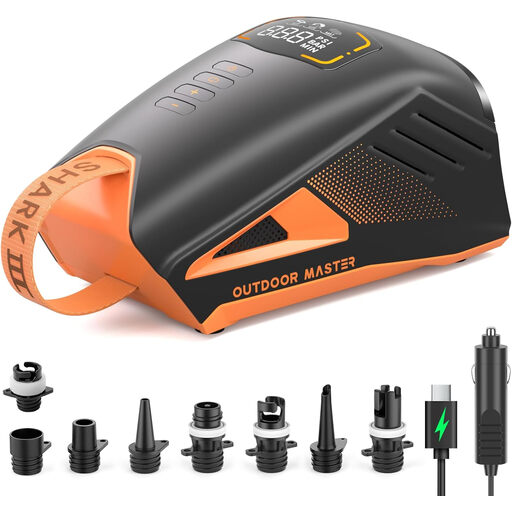
Why It Stands Out The Shark3 focuses on speed and power. With one of the fastest inflation times on the market and a powerful battery, it is designed for users seeking maximum efficiency.
Pros
- High Inflation Speed: According to the manufacturer, it inflates a 10.6-foot board to 15 PSI in just 3 minutes and 50 seconds.
- Powerful Battery: The 74 Wh battery supports the inflation and deflation of up to four boards per charge.
- Fast Charging: The battery is fully charged in approx. 1 hour and 40 minutes via a 45W Type-C port.
- Integrated Cooling System: Prevents overheating and ensures consistent performance.
Who Is It For? This model is aimed at performance-oriented users for whom every minute counts. Anyone who wants to get on the water as quickly as possible and is willing to invest in speed and efficiency will find a suitable electric SUP pump here.
Looking for More Options?
The right pump is the first step to a great day on the water. If you're also looking to expand or upgrade your board equipment, you'll find a wide selection of models for various needs in our category.
? Discover our selection of inflatable paddle boards here
Frequently Asked Questions (FAQ)
1. Can I use any electric air pump for a SUP? No, a special high-pressure pump is required for an inflatable SUP. Standard air pumps designed for air mattresses or inflatable boats do not reach the required pressure of 12-20 PSI, which is necessary for the rigidity and stability of a SUP.
2. How long does it take to inflate a SUP with an electric pump? The time depends on the board's volume, the target pressure, and the pump's performance. Most models take between 8 and 12 minutes to inflate an average board to 15 PSI. More powerful models like the OutdoorMaster pump Shark3 can reduce this process to under 4 minutes.
3. What is the difference between a single-stage and a two-stage pump? Two-stage pumps work more efficiently. The first stage quickly pumps a large volume of air into the board until a low initial pressure is reached. Then, the pump automatically switches to the second stage, a high-pressure compressor, which builds up the final, high target pressure with a lower volume flow. This process is faster and gentler on the materials than with single-stage pumps.