
Bedside Table Buyer’s Guide: How to Choose the Right Model
A bedside table is more than just a surface next to your bed; it's a key piece for keeping your bedroom organised and comfortable. However, the sheer number of options can be overwhelming and lead to poor purchasing decisions. A wobbly frame, mismatched dimensions, or disappointing build quality are common frustrations. This guide will help you identify the crucial criteria and find a model that meets your needs for both function and design.
Common Pitfalls When Buying a Bedside Table
Many products look appealing at first glance but reveal their weaknesses only through daily use. Pay close attention to these three points to avoid making a hasty decision:
- Unstable Construction: A frequent issue with budget-friendly models is the use of thin materials and flimsy joints between the body and legs. The result is a wobbly bedside table that gives way at the slightest touch, making it a precarious spot for a lamp or a glass of water.
- Impractical Dimensions: The height of the bedside table doesn't align with the mattress of your box-spring bed, or its width blocks access to the wardrobe. Many buyers fail to measure the available space accurately and end up with a piece of furniture that integrates poorly into the room.
- Low-Quality Extra Features: A bedside table with a charging station sounds convenient, but often the USB ports are slow or the power strip is inadequately protected. Integrated LED lighting can fail after a short time if the components are not durable.
What Really Matters: The Core Criteria for Your Selection
To find a durable and functional bedside table, you should focus on objective features. The following three aspects are crucial for your long-term satisfaction.
Stability and Material Quality
The longevity of a bedside table is directly linked to the materials used and its construction.
- Material: Models made from MDF (Medium-Density Fibreboard) are generally denser and more stable than those made from simple particleboard. Pay attention to the material thickness; boards that are 15 mm or thicker provide a good foundation for stability. For models with legs, solid wood is a robust choice.
- Construction: Solid screw connections are essential. For a wall-mounted bedside table, the quality of the wall bracket is critical. It must be designed to support the weight of the table and its contents and be installed correctly on the wall. Adjustable feet can help compensate for minor unevenness in the floor.
Dimensions and Space Requirements
The right size is crucial for functionality. Measure the available space precisely before you buy.
- Height: Ideally, the top of the bedside table should be level with the top of your mattress. This makes it easy to reach items from your bed. Common heights range from 50 to 65 cm.
- Width and Depth: For narrow nooks, a slim bedside table, often only 20 to 30 cm wide, is a suitable choice. A small bedside table is also a great option for guest rooms or teen bedrooms. Plan for enough clearance to allow drawers and doors to open completely.
Functional Storage and Tech Features
Consider what you want to keep by your bed.
- Storage: A bedside table with a drawer protects items from dust and creates a tidy, clutter-free look. Open shelves offer quick access to books or a tablet. A set of 2 bedside tables creates a symmetrical look and doubles the storage space for a double bed.
- Tech Extras: With a bedside table with a charging station, you should check the number and type of ports (e.g., USB-A, USB-C) and the cable length. Integrated LED lighting should be controllable via a remote or app and offer various brightness levels to serve as a reading or orientation light.
Our Picks for Different Needs
Here are a few models tailored to specific needs and living situations.

Yaheetech Set of 2 Bedside Tables in Scandinavian Style
Why This Fits Their Persona: Ideal for users who prefer a symmetrical and harmonious bedroom setup. The minimalist design complements many modern interior styles.
The solid wood legs provide a stable base, counteracting the problem of wobbly constructions. The combination of an MDF body and wooden legs is a proven compromise between price and stability.
Comes as a practical set of 2 bedside tables. The drawer offers dust-free storage, while the non-slip feet protect the floor.
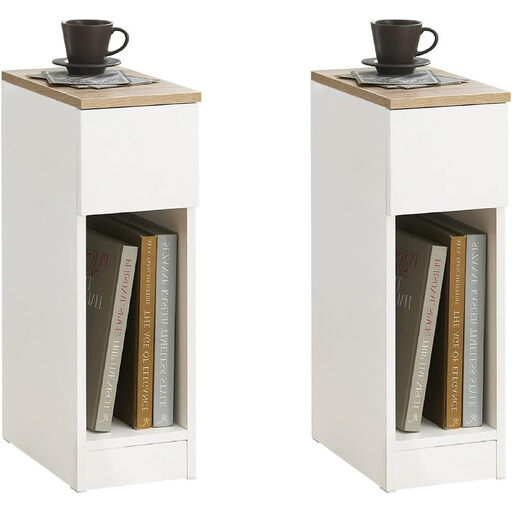
SoBuy Slim Bedside Table, 20 cm Wide
Why This Fits Their Persona: Perfect for anyone needing a solution for very narrow nooks, such as between the bed and a wall or next to a wide box-spring bed.
This model specifically solves the problem of mismatched dimensions. With a width of just 20 cm, it fits into gaps where standard bedside tables are too wide, thus avoiding a typical purchasing mistake.
Despite its small footprint, this slim bedside table offers a surprising amount of storage with a drawer and an open shelf. Felt pads protect the floor.

Woltu Bedside Table with Charging Station and LED Light
Why This Fits Their Persona: For anyone who wants to conveniently charge their smartphone, tablet, and other devices overnight while also creating ambient lighting.
This model integrates technology thoughtfully. The pre-installed power strip with 2 outlets and 2 USB ports, plus a 2-meter cable, is practical and eliminates the cable clutter of separate chargers.
The combination of a bedside table with a charging station and controllable LED lighting (21 modes) in one piece of furniture. Two fabric drawers and an open shelf provide ample storage.
Looking for More Options?
We have compiled a complete, up-to-date list of products that fully meet these strict selection criteria and UK safety regulations.
Frequently Asked Questions
1. How high should a bedside table be? The ideal height for a bedside table depends on the height of your mattress. The top of the table should be roughly level with the top surface of the mattress, typically between 50 and 65 cm. This allows you to comfortably reach your alarm clock, lamp, or a glass of water without having to sit up completely.
2. What is the difference between MDF and particleboard in bedside tables? MDF (Medium-Density Fibreboard) is made from finer wood fibres pressed under high pressure, making it denser, heavier, and more dimensionally stable than particleboard. Particleboard consists of coarser wood chips and is lighter and less expensive. For greater durability and stability, MDF is often the better choice. Look for the E1 classification, which indicates a low-emission board that is safe for your health.
3. Are bedside tables with integrated charging stations safe? Models from reputable suppliers intended for the UK market must comply with current EU and UK safety standards. Look for information on flame-retardant materials and proper installation of electrical components. Do not overload the outlets and ensure the power cable is not bent or damaged.