
2026 Baby Push Walker Recommendations: A Guide to Taking Those First Steps
A child's first independent steps are a significant developmental milestone. During this phase, many parents look for suitable support that offers safety while promoting motor skill development. A baby push walker, often called a walk-behind walker, can be a valuable addition. This article serves as a guide, presenting objective criteria to help you choose the right model for your child. We also feature a selection of products with different characteristics.
What to Look for When Buying a Baby Push Walker?
The decision to get a walker for your baby should be based on safety features, material properties, and your child's individual stage of development. Here are three key points to consider.
1. Stability and Safety Systems
Stability against tipping is the most important criterion. A wide wheelbase and a well-balanced centre of gravity prevent the walker from tipping over during those first, unsteady attempts at walking. A push walker with a brake system offers additional control. On many models, the wheel resistance can be individually adjusted. This allows you to adapt the speed to your child's abilities—slower at first for more support, then smoother-rolling for more advanced walkers. Also, look for rounded edges and sturdy construction to minimise the risk of injury.
2. Material: Wood vs. Plastic
The choice of material affects not only the look but also the weight, durability, and maintenance of the walker.
- Wooden push walkers: Wooden models are often heavier, which gives them excellent stability. They are valued for their durability and longevity. When choosing a wooden push walker, it's advisable to look for certifications like the FSC seal, which stands for wood from sustainable forestry. The surfaces should be treated with non-toxic, water-based paints or oils.
- Plastic push walkers: These are typically lighter and often equipped with a variety of colourful play and learning elements. High-quality plastic such as polypropylene (PP) or ABS plastic is easy to clean and can be simply wiped down. Look for manufacturer claims confirming that the product is free of BPA and phthalates.
3. Age Suitability and Added Play Value
A push walker is generally designed for children who can already sit up independently and pull themselves up on furniture. Most manufacturers provide an age recommendation, often for a walker for ages 1 and up. A good walker not only provides support for walking but also functions as a mobile activity centre. Integrated elements like bead mazes, gears, sliding elements, or small containers for transporting toys promote fine motor skills, hand-eye coordination, and cognitive development.
Our Selection of Baby Walkers for 2026
Based on the criteria mentioned, we have compiled a selection of baby push walkers that focus on different features.
Chicco Happy Hippy Walker
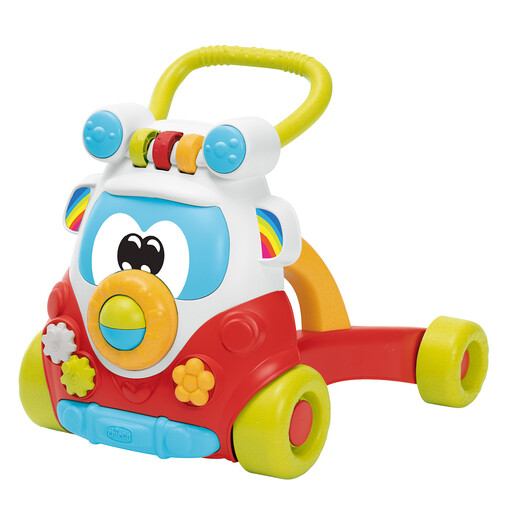
Why it stands out: The Chicco Happy Hippy Walker combines a walk-behind aid with an activity centre in a colourful retro design. The four large wheels ensure stability, while the front panel offers five manual play activities that can also be used while sitting.
Advantages:
- 2-in-1 Functionality: Serves as a support for walking and as a stationary toy.
- Promotes Fine Motor Skills: Equipped with rotating cylinders, movable flowers, and sliding beads.
- Stable Design: Wide wheels and a robust construction help with balance.
- Material: Made from high-quality polypropylene and ABS plastic, stated by the manufacturer to be BPA- and phthalate-free.
Who it's for: Parents looking for a lightweight, multifunctional plastic toy that supports both first steps and fine motor skill development.
View the Chicco Happy Hippy Walker
hauck Wooden Push Walker with Gardener Accessories
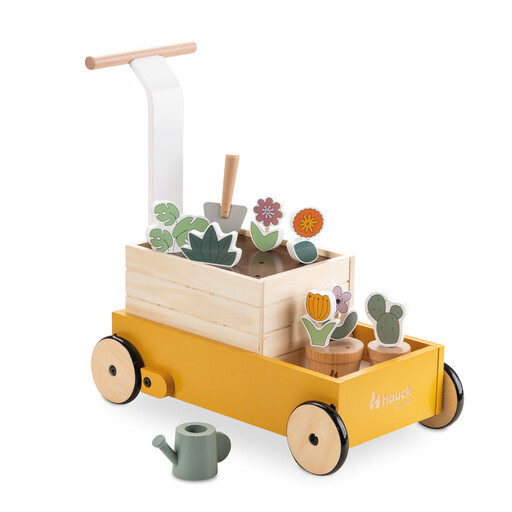
Why it stands out: This push walker from hauck is made from sustainable wood and encourages role-playing with its gardener theme. A special feature is the adjustable brake system, which allows the speed of the wheels to be individually regulated.
Advantages:
- Adjustable Brake System: Allows the wheel resistance to be adapted to the child's developmental stage.
- Sustainable Material: Made from FSC-certified wood, which stands for responsible forest management.
- Encourages Creativity: Includes accessories for role-playing, such as plants and garden tools.
- Storage Space: The large cargo area can also be used to transport dolls or other toys.
Who it's for: Families who value sustainable materials, adjustable safety features, and high play value that goes beyond simply learning to walk.
View the hauck Wooden Push Walker
hauck 2-in-1 Doll's Pram and Push Walker
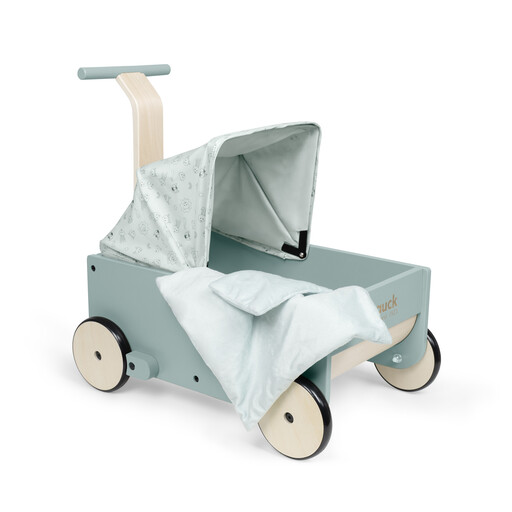
Why it stands out: This model from hauck combines the function of a walk-behind aid with a classic doll's pram. The height-adjustable handle and quiet, rubber-coated wheels make it a durable and floor-friendly companion.
Advantages:
- Grows-with-Your-Child Design: The push handle is height-adjustable (45 to 49 cm) to adapt to the child's size.
- Floor-Friendly and Quiet: Rubber-coated wooden wheels ensure quiet rolling on hard floors.
- Customisable Brake: The speed can be adjusted to the child's walking ability.
- Dual Function: Serves as a baby walker and a doll's pram, extending its useful life.
- Material: Made from high-quality, FSC-certified wood.
Who it's for: Children who love to take their dolls or stuffed animals for a stroll. Ideal for parents looking for a quiet, multifunctional wooden toy that grows with their child.
View the hauck 2-in-1 Doll's Pram and Push Walker
Looking for Something Else?
A push walker primarily supports gross motor development. If you want to specifically encourage your child's auditory perception and sense of rhythm, other toys might be a suitable addition.
Discover our selection of baby musical toys to playfully support early musical development.
Frequently Asked Questions
When is a baby push walker a good idea?
A push walker is suitable for children who can already sit up independently and securely, pull themselves up on objects, and are making their first attempts to stand. This is usually between nine and twelve months of age. It is not designed to teach a child to walk, but rather to support them in their ongoing development and give them confidence.
What is the difference between a push walker and a seated baby walker?
A push walker is a toy that the child pushes in front of them. The child stands on their own feet, supports their own weight, and actively controls their movements. A so-called seated baby walker is a seat frame on wheels that the child is placed into. In a seated walker, the child moves by pushing off with their toes, which can lead to unnatural posture and incorrect movement patterns. For safety and developmental reasons, push walkers are recommended over seated walker models.