
2026 Crib Buyer's Guide: A Guide to Models and Safety
Choosing a crib is a decision that should be based on functional criteria and safety considerations. The key parameters include material properties, structural safety in accordance with EU standards, and adaptability to the child's developmental stages. This guide analyses the technical features of various crib types to provide an informed basis for your decision.
Buyer's Guide: Key Technical Considerations for a Crib
Purchasing a crib requires an evaluation of objective criteria. The following points define the essential technical and safety-related features.
Crib Types and Their Functional Distinctions
The crib's design determines its primary purpose and lifespan.
- Bedside Sleeper: This crib is secured directly to the parents' bed. An open side allows for direct access to the child. The sleeping surface is typically height-adjustable to align with the parents' mattress. The typical surface area is 45x90 cm.
- Crib: The classic crib type for infants and toddlers. Four slatted sides provide a secure sleeping environment. Standard sizes are 60x120 cm and 70x140 cm. Models with removable bars allow the child to get in and out independently later on.
- Convertible Crib: These models are convertible and grow with your child over several years. They start as a crib and can later be transformed into a toddler bed without rails or even a small sofa. This ensures long-term use.
- Toddler Bed: Designed for young children who have outgrown their crib. It often features a low entry point and side guard rails for fall-out protection. The most common size is 70x140 cm.
Safety Features and Standards
Safety is the most critical parameter. In the EU, cribs must meet specific standards.
- DIN EN 716-1/-2: This standard governs the safety requirements for children's beds. It defines, among other things, the height of the side rails (at least 60 cm from the top of the mattress), the spacing between the bars (between 4.5 cm and 6.5 cm), and the structural stability.
- DIN EN 1130: This standard applies specifically to cradles and bedside sleepers, setting requirements for their stability and secure attachment to the parents' bed.
- Materials and Finishes: The paints and materials used must be saliva-resistant and free of harmful substances, in accordance with the EN 71-3 standard. Solid wood offers high stability, while MDF and plywood panels are often used for design-focused elements.
Functional Aspects for Practical Use
- Height-Adjustable Mattress Base: A multi-level adjustable mattress base is easier on parents' backs during the first few months. Later, the base is lowered to prevent the child from climbing out of the crib.
- Convertibility: A convertible crib offers significant practical value. The ability to remove the side rails or convert the crib into a toddler bed considerably extends its lifespan.
- Complete Crib Set: A set that includes not only the crib frame but also a matching mattress, a slatted base, and sometimes bedding or a canopy, ensures that all components are compatible and meet safety requirements.
Our Selection of Cribs for 2026
The following models were selected for detailed analysis based on their specific technical features and functional versatility.
roba Bedside Sleeper & Bassinet safe asleep 3 in 1
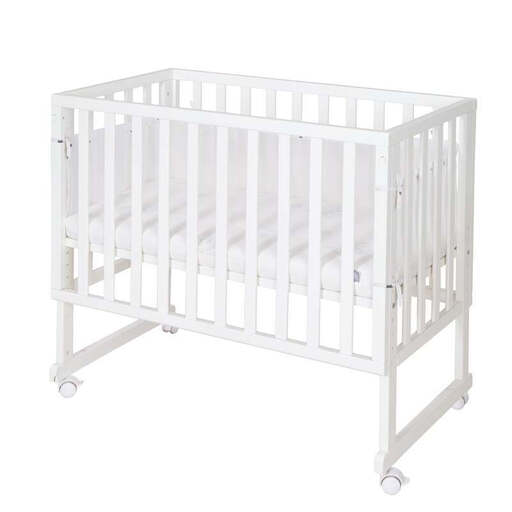
Why we're analysing this product: This model combines three functions—bedside sleeper, bassinet, and children's bench—in a single compact unit. Its compliance with the EN 1130:2019 safety standard and its patented safety barrier are key technical features.
Pros:
- 3-in-1 Functionality: Can be used as a bedside sleeper, a bassinet (with included castors), and later as a bench with a load capacity of up to 65 kg.
- High Adaptability: The sleeping surface is height-adjustable in 7 positions (22.4 cm to 44.6 cm), making it compatible with many parent beds.
- Complete Package: The complete crib set includes a breathable mattress, a fabric barrier, and a safety strap for attachment.
- Safety Concept: Complies with the EN 1130:2019 standard and features a patented canvas barrier and a breathable mesh insert.
Who it's for: Parents looking for a flexible, space-saving solution for the first 6 to 12 months. Its multifunctionality is particularly relevant for households that value the long-term use of furniture pieces.
roba Multifunctional Crib Star Magic Grey
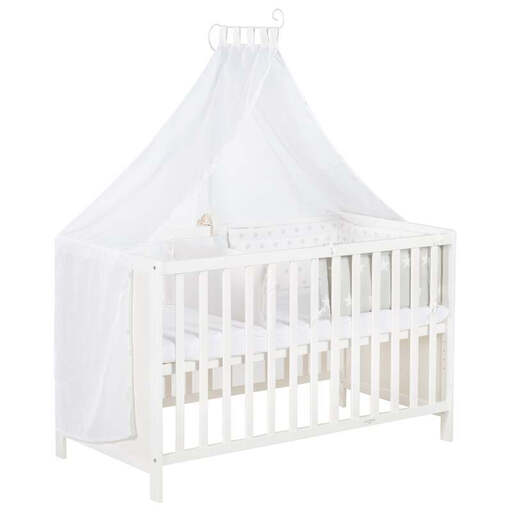
Why we're analysing this product: This convertible crib, with a 60x120 cm footprint, is designed as a long-term solution. It covers all stages of use, from a bedside sleeper and crib to a toddler bed, and complies with the EN 716-1:2017 + AC:2019 safety standard.
Pros:
- Long Lifespan: Suitable for children from 0 to 5 years (up to 50 kg load capacity) thanks to its conversion options.
- Functional Adjustment: 6-position height-adjustable (22 cm to 42 cm) for use as a bedside sleeper. Five removable bars facilitate independent access later on.
- Comprehensive Set: Includes a slatted base, mattress, crib bumper, canopy, and canopy rod.
- Certified Safety: Developed in Germany and certified according to EN 716-1:2017 + AC:2019.
Who it's for: Families looking for an all-in-one solution that will see their child from birth through to preschool age. Its convertibility from a crib to a toddler bed eliminates the need for additional purchases in the early years.
roba Paw Patrol Toddler Bed 70 x 140 cm
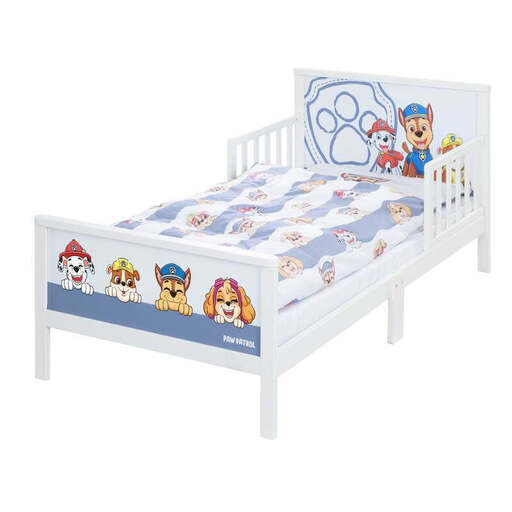
Why we're analysing this product: This toddler bed, in a 70x140 cm size, is designed for the transition from a crib. It follows the Montessori principle of an open bed for independent access and incorporates a design theme popular with children.
Pros:
- Focus on Independence: The low bed height (18 cm + mattress thickness) allows children to get in and out of bed on their own.
- Toddler Safety Features: Side safety barriers at the head of the bed serve as fall-out protection.
- Included Accessories: The delivery includes the slatted base and a matching bedding set (100x135 cm duvet cover, 40x60 cm pillowcase).
- Long-Term Usability: The bed is designed for an age range of 0 to 7 years and a maximum load of 35 kg.
Who it's for: Parents of toddlers (approx. 2 to 7 years) who want to manage the transition to a "big kid" bed. The design specifically appeals to children and can encourage acceptance of the new bed.
Discover More Options and Designs
If the models presented don't exactly meet your requirements, or if you'd like to consider other designs, a wider selection of options can offer additional inspiration. For a bright and neutral room aesthetic in particular, you can find a variety of models in the white beds category.
Frequently Asked Questions (FAQ)
1. How long can a 70x140 cm crib be used? A crib measuring 70x140 cm can typically be used until a child is about 5 to 7 years old, depending on their height and development. If the model is convertible, it can be used as a toddler bed by removing the side rails, which maximises its lifespan.
2. What does 'convertible' mean for a crib? A convertible crib is a grow-with-me crib whose structure can be modified. It usually starts as a crib with the mattress base in a high position. Later, the base is lowered, removable bars are taken out, and finally, the slatted sides are replaced with low side panels to transform it into an open toddler bed.