
All-System Car Diagnostic Tools: Recommendations and Buyer’s Guide
The electronics in modern vehicles are becoming increasingly complex. For professional repairs and advanced maintenance tasks, a simple fault code reader is often no longer sufficient. An all-system car diagnostic tool has become indispensable for workshops and experienced DIY enthusiasts. This article provides guidance on the essential features to look for and presents a selection of recommended tools for 2026.
What to Look for When Choosing a Professional Diagnostic Tool
Selecting the right device depends on your specific needs. However, three criteria are particularly crucial for making a future-proof decision.
1. System Coverage and Protocol Support (CAN FD & DoIP)
A professional diagnostic tool should be able to communicate not just with the engine, but with all control units (ECUs) in the vehicle—from ABS and airbags to the transmission and comfort systems. Support for modern communication protocols is also critical. CAN FD (Flexible Data-Rate) and DoIP (Diagnostics over Internet Protocol) are mandatory for diagnosing newer vehicle models from manufacturers like General Motors, BMW, Volvo, and Jaguar Land Rover. A tool without these protocols will have limited or no functionality on current vehicle generations.
2. Feature Set: ECU Coding and Bi-Directional Control
The ability to do more than just read and clear fault codes is what separates a professional tool from a basic scanner.
- ECU Coding: This function allows you to adapt, reconfigure, or unlock features in control units. After replacing a module, such as a headlight or a power window motor, coding is often necessary to synchronise the new component with the vehicle.
- Bi-Directional Control (Active Test): An active test tool can send commands to vehicle components to check their functionality. For example, you can directly activate a fan, a valve, or a headlight to determine whether the fault lies with the component itself, the wiring, or the control unit. This significantly speeds up the troubleshooting process.
3. Software Updates, Vehicle Coverage, and Service Functions
The automotive industry is constantly evolving. Regular software updates are therefore necessary to ensure compatibility with new vehicle models and systems. Some manufacturers offer lifetime free updates, while others use an annual subscription model. The number of available service functions is also an important criterion. A good Service Reset Tool should cover common maintenance tasks like Oil Service Reset, EPB (Electronic Parking Brake), SAS (Steering Angle Sensor) Calibration, and DPF (Diesel Particulate Filter) Regeneration.
Top Diagnostic Tool Recommendations
Based on the criteria above, we have compiled a selection of tools that are suitable for professional use in workshops as well as for ambitious DIY mechanics.
KINGBOLEN K7
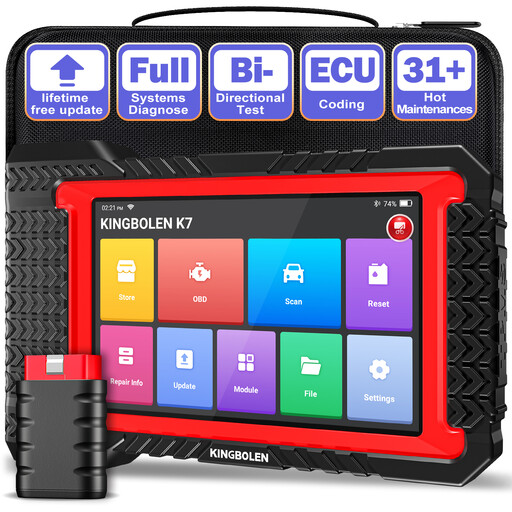
Why It Stands Out: The KINGBOLEN K7 is distinguished by its update model. According to the manufacturer, software updates are free for life, which makes long-term operating costs predictable.
Advantages:
- Lifetime Free Updates: No annual subscription fees for software updates.
- Comprehensive System Diagnostics: Access to all vehicle systems for fault analysis.
- Advanced Functions: Supports ECU Coding (Online and Offline) and Bi-Directional Control (Active Test).
- Service Functions: Offers over 28 service and reset functions, including Oil Reset, ABS Bleeding, and Injector Coding.
- Wireless Diagnostics: The car diagnostic tool with Bluetooth VCI allows for flexible operation without a cabled connection to the vehicle.
- FCA AutoAuth: Enables access to SGW-protected vehicles from the FCA group (Fiat, Chrysler, etc.).
Who Is It For? This device is an attractive option for workshops and DIY mechanics looking for a powerful tool with predictable costs and a comprehensive feature set.
Autel MaxiCOM MK900-BT
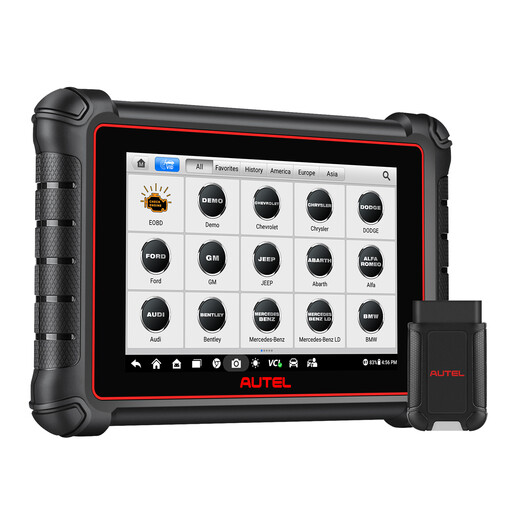
Why It Stands Out: The Autel MK900-BT supports the modern CAN FD and DoIP protocols without additional adapters and offers a very wide range of service functions.
Advantages:
- Modern Protocol Support: Native support for CAN FD and DoIP ensures compatibility with the latest vehicle models.
- Extensive Service Functions: According to the manufacturer, it includes over 40 service and special functions for advanced maintenance tasks.
- Bi-Directional Control: Comprehensive active tests for controlling actuators and quickly identifying faults.
- Wireless Connection: The MaxiVCI V150 provides a stable Bluetooth connection to the vehicle.
- Hardware: Equipped with an Android 11 operating system and an 8-inch touchscreen for smooth operation.
- Expandability: Compatible with add-on modules like the BT506 battery tester or a videoscope (sold separately).
Who Is It For? The MK900-BT is aimed at professional workshops that need a professional-grade fault code reader with broad coverage of modern vehicles and a high number of special functions.
LAUNCH X431 CRP919E BT
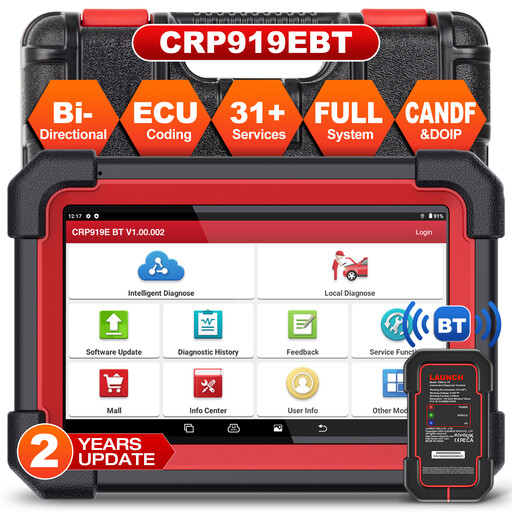
Why It Stands Out: The CRP919E BT is an evolution of the CRP919E, now also integrating CAN FD and DoIP protocols via the new DBScar VII VCI. It offers a balanced combination of diagnostics, service functions, and modern hardware.
Advantages:
- CAN FD & DoIP Support: Ensures compatibility with newer vehicles from GM, BMW, Volvo, and other brands.
- OE-Level System Diagnostics: Allows access to all control units at a level approaching that of the vehicle manufacturers.
- ECU Coding & Active Test: Provides advanced programming and testing functions for in-depth repairs.
- Service Functions: Includes over 31 reset functions that are continuously updated.
- Hardware Upgrade: Runs on Android 10 with 4 GB of RAM and 64 GB of ROM, ensuring fast and stable performance.
- Wireless Diagnostics: The connection via the Bluetooth VCI provides freedom of movement while working on the vehicle.
Who Is It For? This tool is a great choice for workshops and DIY enthusiasts seeking a versatile and future-proof device that offers both modern protocol support and a solid range of coding and testing functions.
Other Options and Specialised Devices
The models presented here cover a broad spectrum of applications. However, if you are looking for a solution for specific requirements, such as a device with a special focus on commercial vehicles, you can find more specialised options in our category for OBD2 Bluetooth Scanners for Diesel Engines.
Frequently Asked Questions (FAQ)
What does ECU coding mean on a diagnostic tool?
ECU coding is an advanced function that allows you to modify the software of a control unit (ECU). This is needed, for example, to register a new component after a replacement (e.g., a new battery or injectors), to unlock hidden vehicle features (e.g., automatic door locking when driving), or to adapt a control unit's configuration to the vehicle's equipment.
Do I need a diagnostic tool with CAN FD and DoIP?
If you regularly work on vehicles built after 2019, support for CAN FD and DoIP is increasingly important. CAN FD is used by manufacturers like General Motors, Ford, and others to enable higher data rates. DoIP is primarily used by European brands such as BMW, Volvo, Jaguar, and Land Rover for fast diagnostics and software updates via Ethernet. Without these protocols, a complete diagnosis of these vehicles is not possible.
What's the difference between a professional all-system diagnostic tool and a basic OBD2 scanner?
A basic OBD2 scanner can typically only access the engine and emissions control unit to read and clear emissions-related fault codes (DTCs). In contrast, a professional all-system car diagnostic tool communicates with all control units installed in the vehicle (ABS, airbag, transmission, air conditioning, etc.). Furthermore, it offers advanced functions like live data display, bi-directional control (active tests), service resets, and ECU coding, which are essential for comprehensive fault diagnosis and repair.