
Airtight Food Storage Containers: What Really Matters When Buying
Airtight food storage containers are designed to protect food from moisture, odours and leaks. In practice, however, many models differ considerably in terms of their closures, materials and everyday practicality. Whether you run a household, have a family, work full-time or study, it is therefore worth taking a close look at the technical specifications before adding a food storage container to your basket.
Typical Problems When Buying Food Storage Containers
1. “Airtight” Does Not Automatically Mean Leakproof
A container can have a tightly fitting lid and still leak if the closure is simply clipped on or the seal does not sit evenly. For soups, sauces and dressings, leakproof food storage containers with a continuous silicone seal and a secure closure are a sensible choice. It is also important to close the lid fully and avoid overfilling the container.
2. Microwave and Freezer Suitability Are Often Misunderstood
“Microwave-safe” often applies only to the container, not the lid. With the products mentioned here, the lid must be removed or fully opened before heating. The maximum temperature is also relevant: some models are designed for temperatures of up to 110 °C, while others can withstand up to 120 °C.
When freezing food, follow the temperature specified by the manufacturer. For LocknLock models, for example, use at temperatures down to -20 °C is stated. Frozen food should be allowed to thaw slightly before opening, as negative pressure or frozen contents can put strain on the seal.
3. Large Sets Do Not Automatically Fit in Every Cupboard
Several food storage boxes only save space if they can be stacked or nested inside one another. Round containers often require more storage space than rectangular models. Before buying, you should therefore check the external dimensions, the shape of the fridge compartment and the available height in your kitchen cupboard.
The Most Important Selection Criteria
Closure and Seal
A four-sided closure distributes the pressure evenly across the seal. The LocknLock Classic range is specified as having a four-sided safety closure and a double silicone seal. This design is appealing to anyone who transports liquids or wants to store food in the fridge while minimising odours.
With screw-top lids such as the LocknLock PP Modular Plus, the focus is on a compact, tightly sealing closure. For everyday use, it is also important that the lid can be opened and cleaned without excessive force.
Material and Food Contact
Many of the containers featured are made from polypropylene (PP). This material is lightweight and widely used for food storage containers. Some products also have a seal made from silicone or TPE. For BPA-free food storage containers, the specific product description should explicitly state “BPA-free”.
Damaged containers or lids should no longer be used. Cracks, severe deformation and brittle seals can impair the airtightness and create sharp edges.
Capacity and Intended Use
- 500 to 750 ml: suitable for snacks, side dishes, small salads or individual portions
- 800 ml to 1.1 l: ideal for leftovers, breakfast and smaller meal-prep portions
- 1.5 to 2.3 l: useful for family portions, larger meals and prepared ingredients
- Several sizes in one set: practical if you regularly store different types of food
For meal prep, rectangular, stackable food storage containers are usually the most space-efficient option. A lunch box with compartments, on the other hand, is better suited to keeping several components of a meal separate.
Our Selection by User Profile
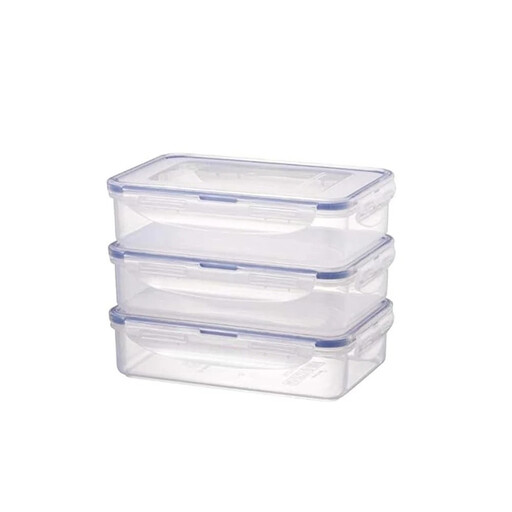
Locknlock Food Storage Container Set, 3-piece, 800 ml each
Why this product suits this profile: Three containers of the same size make it easy to start storing leftovers, snacks and prepared ingredients. The transparent design keeps the contents clearly visible.
The set is stackable and, according to the product description, has airtight lids. The container size remains manageable, helping to avoid buying oversized containers that are not suitable for your needs.
Three containers, 800 ml each; transparent plastic construction; stackable design.
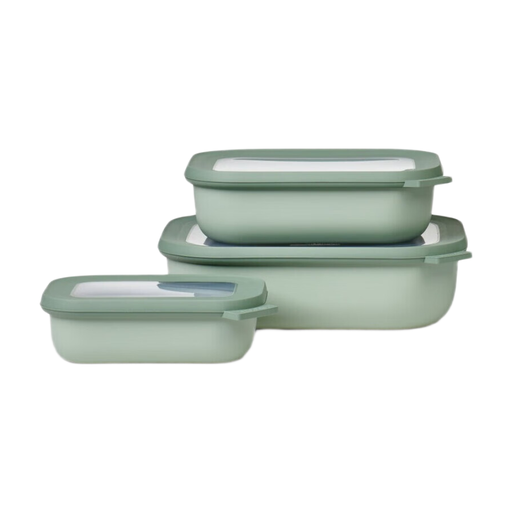
Mepal Cirqula Multi-Bowl Set, rectangular, 500, 1,000 and 2,000 ml
Why this product suits this profile: The set covers several portion sizes and is suitable for the fridge, freezer, microwave without the lid and dishwasher.
The specifications state precise temperature limits of up to 110 °C, as well as the need to remove the lid when heating. This avoids the common mistake of confusing the suitability of the container with that of the lid.
Three sizes; BPA-free PP/TPE; suitable for freezing; dishwasher-safe; stackable and nestable.
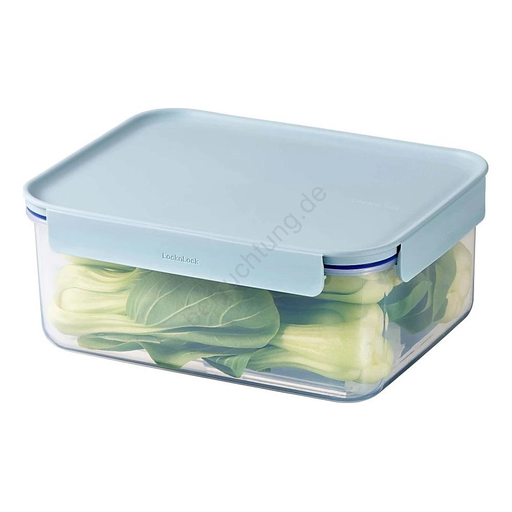
LocknLock PP Modular Plus, rectangular, 2.0 l
Why this product suits this profile: The larger capacity is ideal for family portions, prepared meals and ingredients for several days.
The rectangular shape supports space-saving stacking. The product specifications state that it has an airtight and watertight closure and is suitable for the freezer, microwave and dishwasher.
2.0 l capacity; BPA-free material; stackable; open or remove the lid when heating, as instructed.
Looking for more options?
We have put together a complete, regularly updated list of products that fully meet these strict selection criteria and the safety regulations applicable in the EU.
Care and Safe Use
To keep airtight food storage containers working properly for as long as possible, lids, seals and containers should be cleaned and dried thoroughly after every use. For dishwasher-safe food storage containers, follow the recommended placement, such as using the top rack. Abrasive cleaners and hard brushes can damage plastic surfaces.
When heating:
- Remove the lid completely or open it as instructed.
- Do not exceed the stated temperature limits.
- Remove hot food carefully, as there is a risk of burns.
- Do not place containers on hobs, in the oven or on direct heat unless this is expressly permitted.
Frequently Asked Questions About Airtight Food Storage Containers
Are Airtight Food Storage Containers Suitable for Liquids?
Only models with explicitly stated leakproof properties and an intact seal should be used for liquids. The lid must be fully locked. Extra care is required with carbonated or very hot contents.
How Long Do Food Storage Containers Last?
There is no single lifespan that applies to every container. It depends on how the container is used and cleaned, as well as on temperature changes. Containers should be replaced if they develop cracks, become deformed, have brittle seals or can no longer be closed properly.
What Size Is Best for Meal Prep?
For individual meals, 800 ml to 1.1 l is usually sufficient. Family portions and larger quantities of ingredients often require 1.5 to 2.0 l. If you want to transport different foods separately, you can also choose a lunch box with compartments or a snack box set with dividers.