
Air Purifiers for Allergies: 2026 Buyer's Guide and Recommendations
For individuals who react to airborne particles like pollen, house dust, or pet dander, indoor air quality can play a significant role in their well-being. An air purifier for allergy sufferers is a device designed to reduce the concentration of these suspended particles in the air. Its operation is based on drawing in room air, filtering it, and then expelling the purified air. The effectiveness of such a device depends crucially on the filter technology used and its suitability for the specific room size.
Selection Criteria for an Air Purifier
When choosing a suitable model, several technical parameters must be considered to ensure air purification meets your needs.
1. Filter Technology: The HEPA Standard
The core component of an air purifier is its filtration system. For allergy sufferers, the HEPA filter (High-Efficiency Particulate Air) is particularly important. According to the European standard, filters of this class must remove at least 99.95% (Class H13) or 99.995% (Class H14) of particles with a size of 0.1 to 0.3 micrometres from the air. This includes pollen, mould spores, dust, and pet allergens.
Many devices use a multi-stage system:
- Pre-filter: A washable or replaceable filter that captures coarse particles like hair and lint, extending the life of the main filter.
- HEPA Filter: The core element for capturing fine particulate matter and allergens.
- Activated Carbon Filter: Serves to neutralise odours and volatile organic compounds (VOCs) through adsorption.
2. Air Change Rate (CADR) and Room Size
The Clean Air Delivery Rate (CADR) indicates how many cubic metres of clean air a device delivers per hour. This value is crucial for determining its suitability for a specific room size. A common recommendation is that the air in the room should be completely circulated two to four times per hour. An air purifier for large rooms requires a correspondingly high CADR, whereas a model with lower performance may suffice for a bedroom.
3. Operating Noise (Volume)
A quiet air purifier is especially advantageous for use in the bedroom. The volume is specified in decibels (dB). Models with a special sleep mode often operate at levels below 30 dB, which is roughly equivalent to the volume of a whisper and does not disturb sleep.
4. Sensors and Smart Features
Modern devices often feature particle sensors (e.g., for PM2.5) that measure air quality in real time. In Auto Mode, the device automatically adjusts the fan speed based on the measured particle concentration. A smart air purifier can also be controlled via an app. This allows for remote control, the creation of schedules, and monitoring of the filter lifespan.
Our 2026 Picks
Based on the technical criteria mentioned, we present a few models here that are suited for different use cases due to their specifications.
Levoit EverestAir: For Large Living Spaces
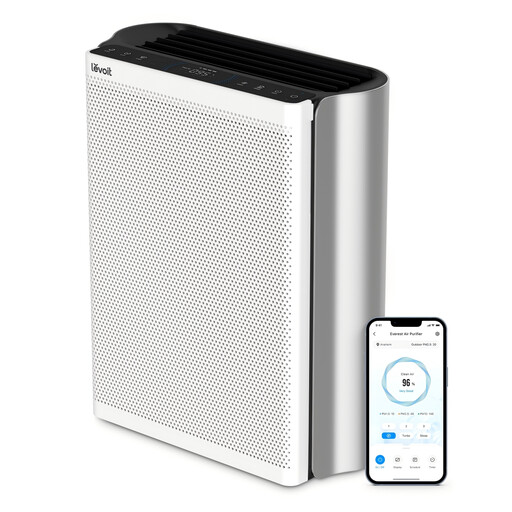
Why We Recommend It The Levoit EverestAir is designed for use in very large rooms. Its ability to filter the air in a 130 m² area twice per hour makes it relevant for open-plan living concepts or large offices. The 3-channel laser dust sensor, which detects PM1.0, PM2.5, and PM10, provides detailed data on air quality.
Pros
- High Purification Performance: Suitable for rooms up to 130 m².
- Advanced Sensors: A 3-channel laser particle sensor measures various particle sizes in real time.
- Adjustable Air Outlet: The airflow can be directed at an angle from 45° to 90° to optimise the distribution of fresh air.
- Easy to Maintain: The pre-filter is washable, which reduces operating costs.
- Smart Control: Complete control via the VeSync app, including schedules and real-time data.
Who It's For This model is suitable for users with large, open-plan living areas who want powerful air purification and detailed insights into their air quality.
Levoit Core Mini Pro: Compact and Quiet
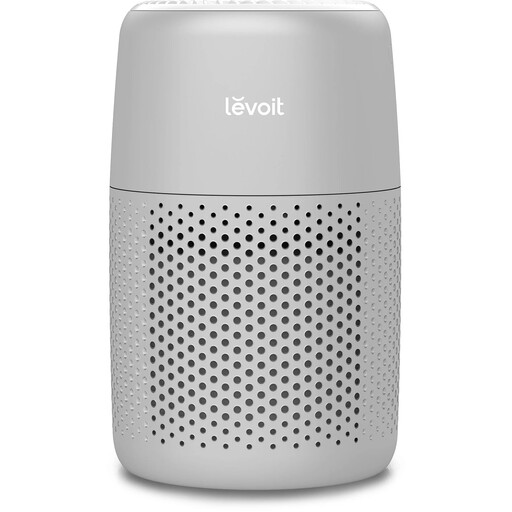
Why We Recommend It The Levoit Core Mini Pro stands out for its compact dimensions and quiet operation. With a noise level of just 27 dB on its lowest setting, it is an option for use in the bedroom or office. The additional aromatherapy function offers another use case.
Pros
- Compact Design: With dimensions of 16.4 × 16.4 × 26.4 cm, it fits on any desk or nightstand.
- Quiet Operation: At 27 dB on the lowest setting, it's suitable for noise-sensitive environments.
- 3-Stage Filtration: Despite its size, it integrates a system of pre-, HEPA, and activated carbon filters.
- Low Energy Consumption: The device operates at a power of 7 watts.
- Aromatherapy Function: Allows for the addition of essential oils to scent the air.
Who It's For Ideal for individuals looking for a solution for smaller rooms like bedrooms, children's rooms, or home offices, who also value exceptionally quiet operation.
Levoit Core 300S Pro: Smart All-Rounder
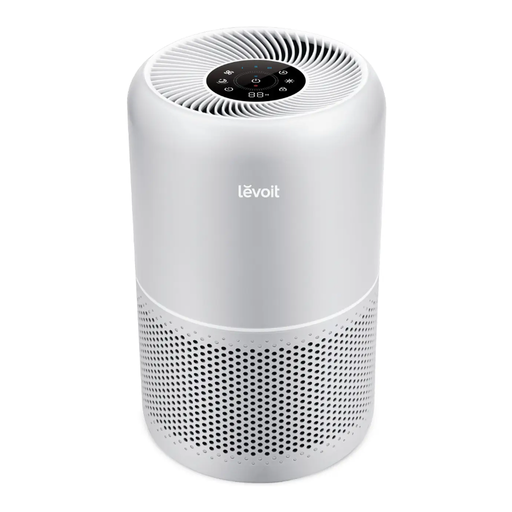
Why We Recommend It The Levoit Core 300S Pro offers a balanced combination of performance, intelligent features, and quiet operation. The laser sensor for PM2.5 particles enables a precise Auto Mode that adjusts the fan speed as needed. Compatibility with voice assistants enhances user convenience.
Pros
- Precise Auto Mode: A laser sensor monitors the PM2.5 concentration and automatically controls the performance.
- Comprehensive Smart Control: Operation via the VeSync app as well as voice control through Alexa and Google Assistant.
- Effective Filtration: The 3-stage filtration system removes 99.97% of particles down to 0.1–0.3 μm in size, according to the manufacturer.
- Ultra-Quiet Sleep Mode: Operation in sleep mode is optimised for undisturbed sleep.
- Intuitive Operation: Can be controlled intuitively via the touch panel as well as remotely via the app.
Who It's For This model is a great choice for users seeking an air purifier for dust and pollen for medium-sized rooms like living rooms or bedrooms, who appreciate the convenience of automatic functions and smart control.
Discover More Models
The market offers a wide variety of devices with different specifications for diverse requirements and room sizes. If the models presented here do not exactly meet your needs, you can find a broader selection of devices in our HEPA Filter Air Purifiers category.
Frequently Asked Questions (FAQ)
1. How often do you need to change the HEPA filter in an air purifier? The lifespan of a HEPA filter depends on the duration of use and the level of air pollution. As a rule, manufacturers recommend a replacement every 6 to 12 months. Many modern devices have a filter replacement indicator that informs the user in a timely manner.
2. Does an air purifier really help with pet hair and odours? Yes, a multi-stage filtration system is designed for this purpose. The pre-filter captures larger particles like pet hair. The activated carbon filter specialises in binding and neutralising odour molecules, for example from pets or cooking, through adsorption.
3. What is the best placement for an air purifier? For optimal performance, the device should be placed on a level surface with a clearance of at least 30-50 cm from walls, furniture, or curtains. This ensures that the air intake and outlet are not blocked and that air can circulate freely in the room. Placing it in a corner of the room is less efficient.