
AAA Rechargeable Batteries: A Buyer's Guide for 2026
Choosing the right AAA rechargeable battery is a technical decision that depends on the specific requirements of your device. Rechargeable AAA-size batteries, also known as rechargeable micro batteries, are used in a wide variety of household devices—from remote controls and wireless mice to children's toys. The choice between different technologies like Nickel-Metal Hydride (NiMH) and Lithium-Ion (Li-ion), as well as varying capacities and charging options, critically impacts performance and cost-effectiveness. This article analyses the technical parameters relevant to making an informed purchasing decision.
Buying Guide: Technical Criteria for Selecting AAA Rechargeable Batteries
To identify the most suitable rechargeable AAA batteries, several technical specifications should be considered. These factors determine the batteries' compatibility, performance, and lifespan.
Battery Technology: NiMH vs. Lithium-Ion (Li-ion)
The battery's chemical composition is a fundamental aspect.
- NiMH AAA Battery (Nickel-Metal Hydride): This technology is widespread and often characterized by a high nominal capacity, measured in milliampere-hours (mAh). NiMH batteries typically deliver a voltage of 1.2 volts. They are a proven solution for many standard applications where maximising runtime per charge is the priority.
- Lithium-Ion AAA Battery (Li-ion): Modern Li-ion batteries offer a constant 1.5-volt output throughout the entire discharge cycle. This can improve performance in devices optimised for the 1.5-volt standard of disposable alkaline batteries. Additionally, they generally exhibit lower self-discharge rates and enable innovative charging concepts, such as integrated USB-C ports.
Capacity (mAh and mWh)
Capacity indicates how much energy a battery can store.
- Milliampere-hours (mAh): This unit describes how long a battery can supply a specific current. For example, a 1000mAh AAA battery can theoretically deliver a current of 1000 milliamperes (mA) for one hour or 100 mA for ten hours.
- Milliwatt-hours (mWh): This unit also accounts for voltage (Energy = Voltage × Charge). It is particularly useful for objectively comparing batteries with different nominal voltages (e.g., 1.2V NiMH vs. 1.5V Li-ion). A battery with a higher mWh rating delivers more total energy.
Voltage (V): The Significance of 1.2V vs. 1.5V
The nominal voltage is crucial for the compatibility and function of some devices. While most devices are tolerant of the lower 1.2V from NiMH batteries, voltage-sensitive electronics like certain medical devices, game controllers, or string lights can exhibit more stable and prolonged performance with a 1.5V AAA battery. The constant voltage of a Li-ion battery prevents performance degradation as the charge level drops.
Charging Options: External Charger vs. AAA Battery with USB-C
The charging method affects user convenience.
- External Charger: The traditional method for NiMH batteries. It requires a separate charger but often allows for the simultaneous charging of multiple batteries.
- Integrated USB-C Port: A modern solution found primarily in Li-ion batteries. It allows for charging directly on the battery via a standard USB-C cable, eliminating the need for a dedicated charger and increasing flexibility.
Our Top Picks for 2026
Based on the aforementioned technical parameters, we present two models that cater to different user profiles.
VERICO LoopEnergy AAA 900: Lithium-Ion Technology with USB-C
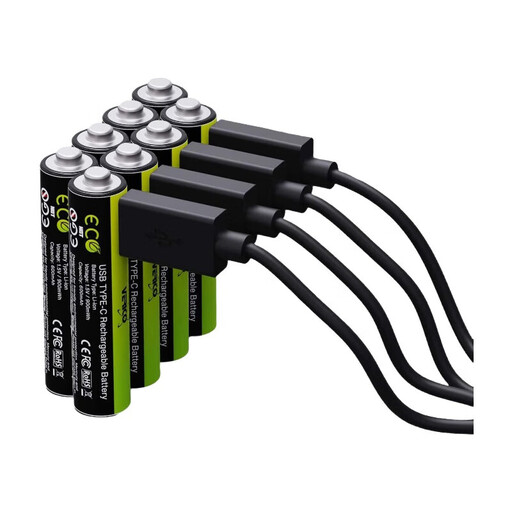
Why We Recommend This Product The VERICO LoopEnergy AAA 900 uses Lithium-Ion AAA battery technology to deliver a constant 1.5-volt output. This ensures consistent performance in demanding devices. The integrated AAA battery with USB-C charging port offers great flexibility, as no separate charger is required. With the included 4-in-1 charging cable, four batteries can be charged simultaneously from any USB-A source.
Advantages
- Stable 1.5V Voltage: Ensures consistent device performance until fully depleted.
- Direct Charging via USB-C: Allows for charging without a dedicated charger, for instance, from a power bank or laptop.
- Low Self-Discharge: The batteries remain ready for use even after long-term storage.
- Comprehensive Accessory Kit: The set includes eight batteries, a 4-in-1 charging cable, and a storage case.
Who It's For This model is designed for tech-savvy users who value modern charging technologies and a stable power supply. It is particularly suitable for high-drain devices like game controllers, digital cameras, or electronic toys, where a voltage drop could impair functionality.
VARTA Recharge Accu 1000 mAh: High Capacity for Standard Applications
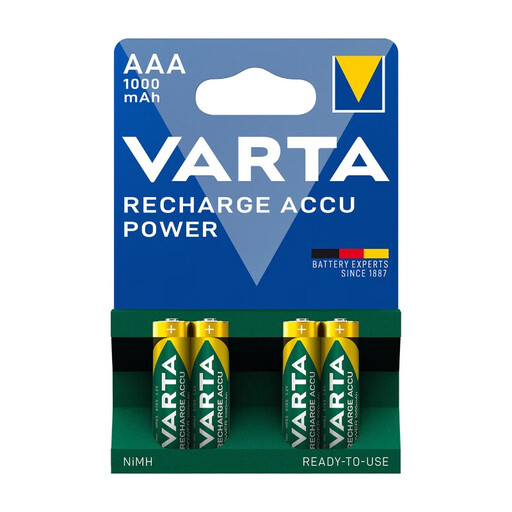
Why We Recommend This Product The VARTA Recharge Accu 5703 is a classic NiMH AAA battery with a high capacity of 1000 mAh. It is designed for maximum runtime per charge cycle. Thanks to its "Ready to Use" technology, self-discharge is reduced; according to VARTA's internal tests, the batteries retain 65% of their capacity after 12 months of storage. Its compatibility with all standard NiMH chargers makes it a universal solution.
Advantages
- High 1000 mAh Capacity: Provides long operating times in devices with moderate to high energy consumption.
- "Ready to Use" Technology: The batteries come pre-charged and are ready to use right out of the box.
- Universal Compatibility: Can be used in all devices and with all chargers suitable for NiMH batteries.
- Established Brand: VARTA is a renowned manufacturer in the battery technology sector.
Who It's For This product is aimed at cost-conscious and eco-friendly users and families seeking a reliable power source for a wide range of everyday devices. It is ideal for remote controls, wall clocks, wireless keyboards, and children's toys, where long runtime is more critical than a precise 1.5V output.
Other Options and Alternatives
If the featured models don't perfectly match your requirements, or if you are looking for different sizes, you can find a broader selection of power solutions in our Standard Battery category. Additional rechargeable and standard batteries with various specifications are listed there.
Frequently Asked Questions (FAQ)
1. Can I use a 1.5V AAA rechargeable battery in any device designed for AAA batteries?
Yes, a 1.5V AAA battery based on Li-ion technology is designed to precisely mimic the voltage of a standard alkaline battery. It can therefore be used in any device intended for AAA batteries. In voltage-sensitive devices, it can even lead to better performance than a 1.2V NiMH battery.
2. What does the mAh rating on a AAA battery mean?
The mAh (milliampere-hour) rating is a measure of electrical charge and, consequently, the battery's capacity. A battery with a higher mAh number can power a device for longer at the same current draw. For instance, a 1000mAh AAA battery has a higher capacity than a 600mAh model and thus offers a longer runtime per charge.
3. How long does a rechargeable AAA battery last?
The lifespan of a rechargeable battery is measured in charge cycles. One charge cycle corresponds to a full discharge followed by a full recharge. Depending on the technology and quality, a battery can endure several hundred to over a thousand charge cycles. According to the manufacturer, Li-ion batteries like the VERICO LoopEnergy can replace up to 1000 disposable batteries, which highlights their long service life.