
Guide to Buying a 4K Action Camera
Whether you're mountain biking, diving on holiday, or vlogging for your channel, a 4K action cam promises to capture life's most exciting moments in stunning quality. However, the market is flooded with technical promises that often fall short in practice. Many buyers invest in a device only to find that its advertised performance doesn't meet their expectations. This guide will help you identify the crucial features and avoid common purchasing traps.
The 3 Most Common Traps When Buying an Action Cam
Before you make a decision, you should be aware of the most common marketing ploys that often lead to disappointment.
- The "4K Resolution" Trap: Many budget-friendly models advertise 4K but only deliver this resolution at a low frame rate (e.g., 15 or 24 fps). Such recordings appear choppy during fast movements and are unsuitable for action scenes. True, smooth 4K video requires at least 30 frames per second (fps).
- Vague Claims About Image Stabilisation: The term "image stabilisation" is not a protected standard. Basic electronic image stabilisation (EIS) often crops the image heavily and fails in low-light conditions. A high-quality camera with image stabilisation uses advanced gyro sensors (e.g., 6-axis stabilisation) or even a mechanical suspension (gimbal) to effectively compensate for shakes.
- Unrealistic Battery Life: The battery life stated by the manufacturer is often measured under optimal conditions, such as recording in 1080p with the display turned off. As soon as you start filming in 4K, connect to Wi-Fi, and use the display, the actual runtime can drop dramatically.
What Really Matters: The Crucial Features of a 4K Action Cam
To make an informed decision, focus on the following objective parameters. These determine the true performance and utility of your camera.
True 4K Resolution and High Frame Rate
A high resolution alone isn't meaningful. Pay attention to the combination of resolution and frame rate.
- 4K at 30/60 fps: This is the standard for fluid and detailed action shots. 60 fps also allows for smooth slow-motion playback without any loss of quality.
- 1080p at 120 fps (or higher): High frame rates at a lower resolution are essential for creating impressive slow-motion footage that captures fast movements in detail.
Type and Quality of Image Stabilisation
Stabilisation is the heart of any good sports camera. Without it, footage from activities involving movement is barely usable.
- 6-Axis Gyro EIS: This technology uses a gyro sensor to detect and digitally compensate for movement across six axes. It offers a good balance between performance and a compact design.
- Mechanical Gimbal: Here, the camera is physically stabilised on a motorised mount. This is the most effective method and delivers cinematic, fluid footage, often found in a dedicated vlogging camera.
Waterproofing and Durability
An action cam must be able to withstand the elements. However, claims about waterproofing require a closer look.
- Waterproof without a case: Some models are natively waterproof to a certain depth (e.g., 10 or 18 metres). This is convenient for spontaneous use in the rain or while snorkelling.
- Waterproof with a case: Most cameras, especially more affordable models, require a separate underwater housing to reach depths of 30 metres or more. Check if this is included with your purchase.
Select Suggestions Based on Needs
Instead of making a one-size-fits-all recommendation, we have identified models tailored to specific needs and budgets.
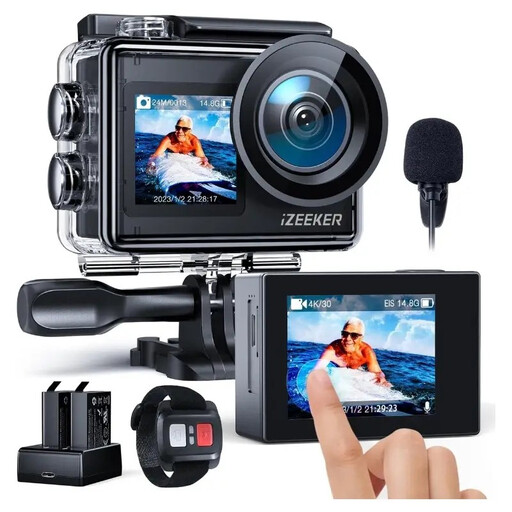
iZEEKER iA200 Action Cam 4K 30FPS 20MP 40M Waterproof
Why this model is a good fit: It offers a solid entry into the world of 4K without breaking the bank. Ideal for casual holiday and sports recording where basic functions and a comprehensive accessory bundle are the priority.
Delivers true 4K footage at 30 frames per second and functional electronic image stabilisation (EIS), which is not a given in this price range and avoids the "4K trap."
A comprehensive accessory package, including a remote control and a waterproof case rated to 40 metres, is already included in the box.
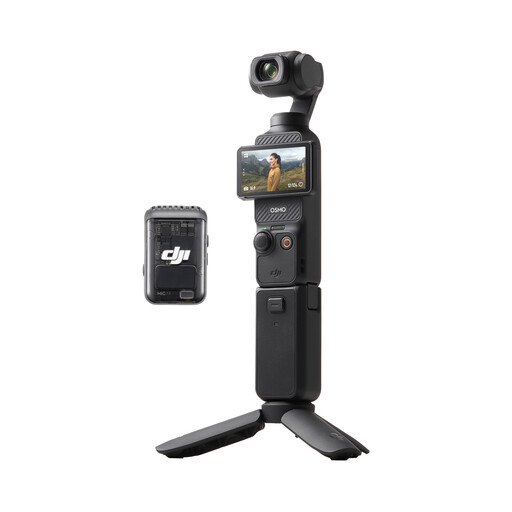
DJI Osmo Pocket 3 Creator Kit, 4K/120fps, 1-inch Sensor Gimbal Camera
Why this model is a good fit: Perfect for vloggers who need maximum image stability and ease of use for professional-looking content. The rotating screen and large sensor are optimised for filming people and scenes.
Instead of basic electronic stabilisation, it features a mechanical 3-axis gimbal that physically compensates for shakes, ensuring extremely smooth footage—the ultimate solution to the "weak stabilisation" trap.
Large 1-inch CMOS sensor for high image quality even in low light and ActiveTrack 6.0 for reliable subject tracking. The Creator Kit also includes a DJI Mic 2 for professional audio.
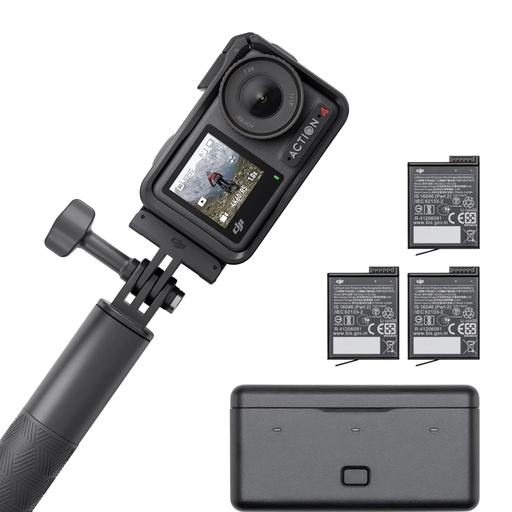
DJI Osmo Action 4 Adventure Combo - 4K/120fps Waterproof Camera
Why this model is a good fit: Engineered for use in extreme conditions, from freezing temperatures to deep underwater adventures. Its rugged build and long battery life make it a reliable companion for any **helmet camera** application.
The battery is explicitly cold-resistant down to -20°C (-4°F), and the camera is waterproof to 18 metres without an additional case. This bypasses the trap of unrealistic battery and durability promises.
The 10-bit & D-Log M colour profile allows for professional colour grading. The 360° HorizonSteady feature keeps the horizon level even during extreme camera rotations.
Looking for More Options?
We have compiled a complete, up-to-date list of products that fully meet these strict selection criteria and safety standards.
Frequently Asked Questions (FAQ)
How long does an action cam battery really last when recording in 4K?
The actual battery life for 4K recording varies greatly depending on the model, ambient temperature, and enabled features (display, Wi-Fi). Realistically, most cameras offer between 60 and 90 minutes of continuous 4K recording. Models like the SJCAM C400 or the DJI Osmo Action 4 provide longer runtimes through extra batteries or optimised battery systems, making them better suited for extended outings.
Do I need a special memory card for a 4K action cam?
Yes, this is essential. A high-speed microSD card is required to handle the large amount of data from 4K video. Look for cards with the U3 (UHS Speed Class 3) or V30 (Video Speed Class 30) rating. These guarantee a minimum write speed necessary for smooth, stutter-free 4K recording. Slower cards can lead to recording interruptions or corrupted files.
What is the difference between a GoPro and other brands like DJI or SJCAM?
GoPro is considered the pioneer of the action cam market and is known for its rugged design and extensive accessory ecosystem. DJI has established itself as a strong competitor, often focusing on innovations in image stabilisation (e.g., with the Osmo Pocket series) and sensor size. Brands like SJCAM often position themselves as a GoPro alternative with a focus on a great price-to-performance ratio, offering many features like dual displays or comprehensive accessory bundles at a more accessible price point.