
22kW Wallbox: 2026 Buyer's Guide and Recommendations
Purchasing an electric car raises a key question: How can you charge it at home efficiently, safely, and cost-effectively? With a wide array of options—from permanently installed wallboxes to mobile chargers—choosing the right charging solution can seem complex. This guide serves as an objective resource to help you understand the technical differences and make an informed decision for your personal home EV charging station.
What to Look for When Choosing a Charging Solution
Three key criteria will help you find the right equipment for your vehicle and living situation.
1. Charging Power: 11 kW or 22 kW?
The charging power determines how quickly your vehicle's battery is charged.
- 11 kW Charging Solutions: These are sufficient for most home use cases and can fully charge a typical EV overnight. A major advantage is the simplified registration process: an 11 kW charger only needs to be reported to the responsible grid operator.
- 22 kW Charging Solutions: A 22 kW wallbox halves the charging time compared to the 11 kW version. This is particularly relevant for drivers with high daily mileage or for vehicles with very large batteries. However, note that the installation of a 22 kW station requires prior approval from the grid operator. In both cases, a 3-phase charging cable is required to utilise the full power.
2. Safety and Standards Compliance
Safety is the top priority when charging electric vehicles. Look for products that comply with European standards (e.g., IEC 62196) and bear the CE mark. A TÜV-certified charging cable or a similarly certified wallbox indicates that the product has been tested for safety and quality by an independent body. Other important features include integrated protection mechanisms against fault currents (e.g., DC fault current detection), overvoltage, and overheating, as well as an adequate IP rating (e.g., IP54 or higher) for outdoor use.
3. Features and Flexibility
Modern charging stations offer more than just charging.
- A wallbox with app control allows you to start, stop, and monitor charging sessions remotely. You can schedule charging times to take advantage of cheaper off-peak electricity tariffs and accurately track your power consumption.
- A mobile wallbox offers a flexible alternative. This device is not permanently mounted on a wall but is instead plugged into an existing high-power socket (e.g., CEE). This makes it ideal for users who want to charge at different locations, such as at home and at a holiday home.
Our Selection of Charging Solutions for 2026
Based on the criteria mentioned, we have compiled a selection of products that cover a range of different needs.
GONEO Type 2 EV Charging Cable 22kW 7m
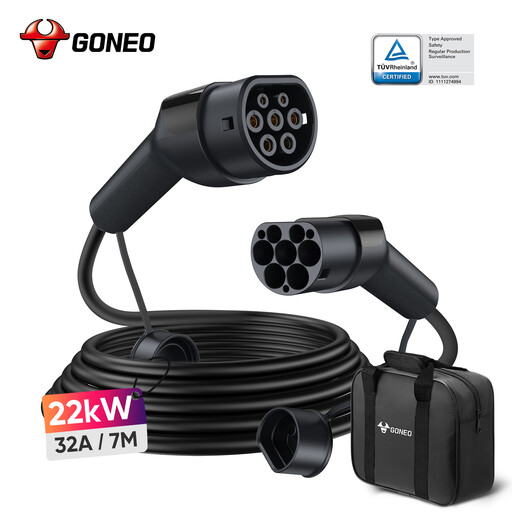
Why it stands out: This product is not a charger, but a high-quality connection cable for public charging stations or existing wallboxes with a Type 2 socket. Its TÜV Rheinland certification and robust construction with ultrasonically welded, silver-plated contacts ensure safety and durability.
Pros:
- Power: Supports charging sessions up to 22 kW (32A, 3-phase).
- Safety:TÜV-certified charging cable, compliant with CE, UKCA, and IEC standards.
- Durability: High-quality TPU cable sheath, IP54 protection against dust and water, run-over and drop-proof.
- Length: 7 metres provide good flexibility at most charging points.
Who it's for: EV drivers who already have access to a charging station with a Type 2 socket and need a reliable, long, and exceptionally durable Type 2 charging cable for daily use.
feyree Type 2 Portable EV Charger 11kW with App
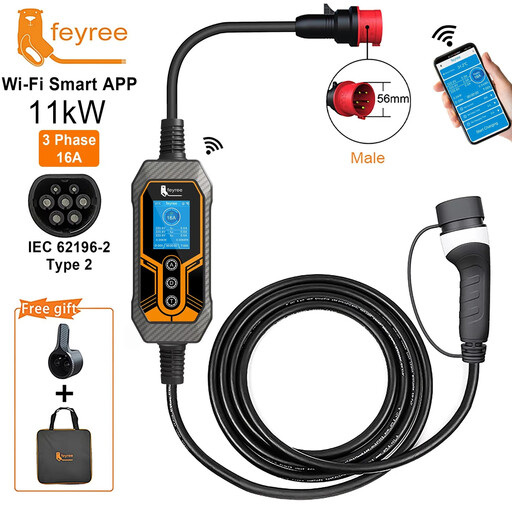
Why it stands out: This mobile wallbox combines flexibility with smart features. Via a Wi-Fi and Bluetooth-enabled app, you can schedule charging times and adjust the charging current to optimise electricity costs or ease the load on the power grid.
Pros:
- Smart Control: Scheduled charging and current adjustment (8A to 16A) via app.
- Information Display: A 2.8-inch LCD screen shows the charging status in real-time.
- Comprehensive Protection: Integrated leakage protection (Type B: AC 30mA + DC 6mA), overvoltage, and overheating protection.
- Portability: Connection via a CEE plug allows for use in various locations.
Who it's for: EV owners who cannot or do not want to install a permanent wallbox and are looking for a portable charging solution with the benefits of app control. Ideal for charging at up to 11 kW.
feyree EV Charger 22kW Wallbox with App Control
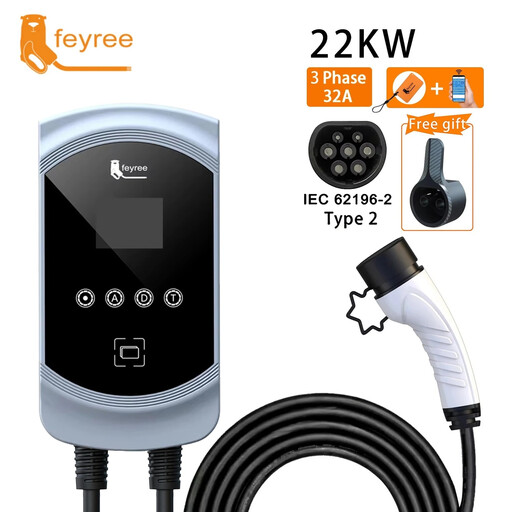
Why it stands out: This permanently installable 22 kW wallbox offers maximum charging power for home use, paired with comprehensive smart home features via the Tuya Smart App. The ability to flexibly adjust the charging current makes it a future-proof choice.
Pros:
- High Charging Power: Up to 22 kW (32A, 3-phase) for very fast charging sessions.
- Comprehensive App Control: Remote control, charge scheduling, current adjustment (8A to 32A), and monitoring via the Tuya App.
- Access Control: An RFID card function can restrict access to authorised users.
- Weather Resistance: The IP65 protection rating ensures safe outdoor operation.
Who it's for: Homeowners and business owners who are looking for a powerful, permanently installed home EV charging station or for a company car park, and who value maximum control and smart features.
Looking for More Options?
If the models presented don't exactly meet your requirements, or if you're looking for different cable lengths, power levels, or specific features, it's worth taking a look at our extended range. There you will find a wide array of charging solutions designed for various vehicle models and use cases.
Discover our full range of EV Charging Connectors and find the right solution for your vehicle.
Frequently Asked Questions
Does a 22kW wallbox require approval?
Yes. In Germany, according to the technical connection rules, the installation of a charging station with more than 11 kW of power (which includes a 22 kW wallbox) must be approved by the responsible grid operator before it is commissioned. A charging station up to 11 kW only needs to be reported. In all cases, the installation should be carried out by a qualified electrician.
Can I charge a car that only supports 11kW with a 22kW wallbox?
Yes, that is perfectly possible. The vehicle's on-board charger communicates with the wallbox and automatically limits the charging power to the maximum that the car can accept. Therefore, a 22 kW wallbox will charge an 11 kW-capable vehicle at 11 kW. This makes you flexible for future vehicles that may have a higher charging capacity.
What is the difference between a wallbox and a mobile wallbox?
A classic wallbox is permanently mounted on a wall and connected directly to the building's electrical system. A mobile wallbox, often referred to as a portable charger or a "charging brick" for high-power current, is instead plugged into an existing industrial socket (e.g., a red CEE 16A or CEE 32A socket). It offers more locational flexibility, whereas the permanently installed wallbox is often considered the most durable and seamlessly integrated home solution.