
20000mAh Power Bank: 2026 Buyer's Guide and Recommendations
A 20000mAh power bank offers a substantial power reserve for your mobile devices. However, choosing the right model involves looking beyond the simple capacity rating at specific technical specifications. This guide breaks down the key criteria and showcases a curated selection of models, each with a distinct functional focus.
Buyer's Guide: What to Look for in a 20000mAh External Battery
Your choice of power bank should be based on an analysis of your individual needs. The following technical specifications are crucial in this decision.
Capacity: Rated Capacity vs. Cell Capacity
The 20000mAh (milliampere-hours) rating describes the capacity of the internal battery cells, typically at a voltage of 3.7 volts. The energy actually delivered to your device, the rated capacity, is lower due to voltage conversion losses and internal circuit efficiency. A realistic value for the rated capacity of a 20000mAh power bank is often between 12,000mAh and 13,500mAh at an output voltage of 5 volts. Check the manufacturer's stated rated capacity to accurately calculate the number of possible charge cycles for your device.
Charging Speed and Protocols (Watts & PD/QC)
Charging speed is measured in watts (W). Modern devices use fast-charging protocols to minimise charging time.
- Power Delivery (PD): A universal standard via USB-C that enables high power output. A power bank for laptops should provide at least 45W, ideally 65W or more, via PD.
- Quick Charge (QC): A standard developed by Qualcomm, common in Android smartphones.
- Other Protocols: Standards like PPS (Programmable Power Supply), AFC (Samsung), or SCP (Huawei) ensure compatibility and maximum charging speeds for specific device brands.
A fast-charging power bank should support several of these protocols to ensure broad compatibility.
Ports and Form Factor
The type and number of ports determine the power bank's flexibility.
- USB-C: The current standard for both input and output. A USB-C port with Power Delivery is essential for fast-charging smartphones, tablets, and laptops.
- USB-A: Widely used for older devices and accessories.
- Integrated Cables: A power bank with a built-in cable (usually USB-C or Lightning) adds convenience, as you don't need to carry a separate one.
- Wireless Charging: A wireless power bank enables cable-free charging via the Qi standard. Models with magnetic attachment (MagSafe power bank) are particularly practical for recent iPhone generations.
Safety Features
Look for built-in protection mechanisms against overcharging, deep discharge, overvoltage, overcurrent, and short circuits. Certifications like CE and RoHS confirm compliance with European safety and environmental standards.
Our Top Picks for 2026
Based on the technical criteria above, we've curated a selection of power banks designed to meet a variety of user profiles.
CUKTECH 15 Ultra Power Bank 20000mAh 140W
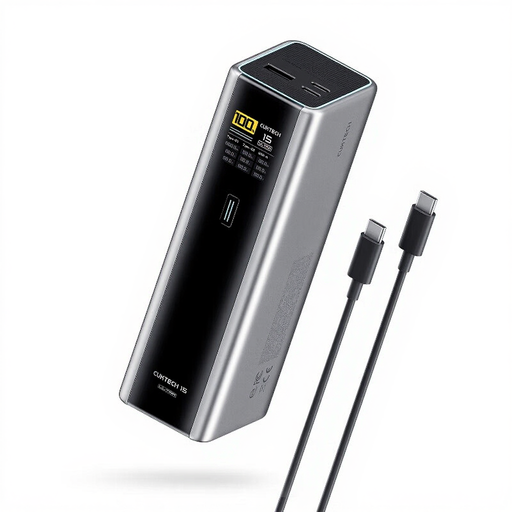
Why We Recommend It This model is engineered for maximum performance. With 140W of output via the PD3.1 standard, it can charge demanding devices like modern laptops (e.g., MacBook Pro) at high speed. The three USB-C ports allow for simultaneous charging of multiple devices.
Pros
- Extremely high 140W output (PD3.1)
- Three USB-C ports for parallel charging
- Suitable for laptops, tablets, and smartphones
- High 20000mAh capacity
Who It's For For professional users, digital nomads, and tech enthusiasts who need a single mobile charging solution for their entire device ecosystem, including high-performance laptops.
CUKTECH 45W 20000mAh Power Bank with Integrated USB-C Cable
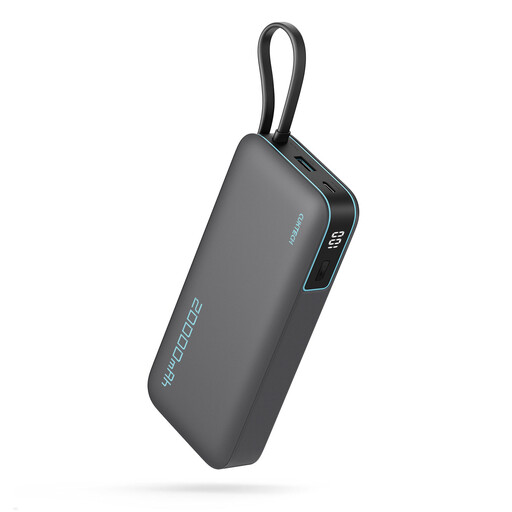
Why We Recommend It This model combines high capacity with maximum convenience. The built-in USB-C cable, which doubles as a carrying loop, makes separate cables redundant. Its 45W output is sufficient to efficiently charge smartphones, tablets, and even ultrabooks like the MacBook Air.
Pros
- Integrated USB-C cable and carrying loop
- 45W fast-charging power (PD)
- Smart digital display for charge level (0-100%)
- Can charge up to three devices simultaneously
Who It's For For commuters, students, and travellers looking for a straightforward, all-in-one solution who don't want to carry multiple cables. A practical portable charger for iPhone 15/16 and Android devices.
DigiEra Magnetic Wireless Power Bank 5000mAh
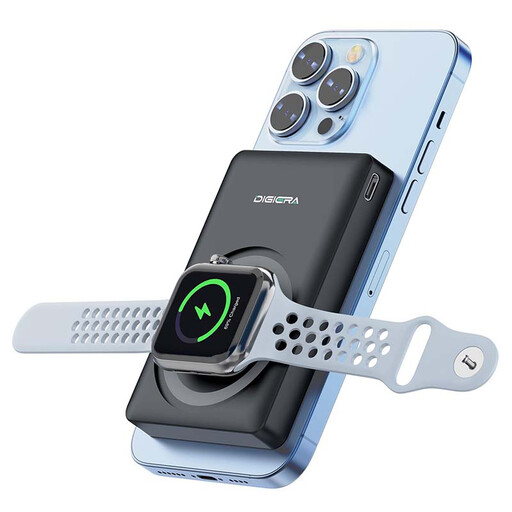
Why We Recommend It Although this model doesn't have the 20000mAh capacity of our main focus, it's a relevant addition for users who prioritise portability and special features. With 5000mAh, MagSafe compatibility, and a weight of just 123g, it's an extremely compact solution for daily needs.
Pros
- 15W magnetic wireless charging (MagSafe-compatible)
- 20W wired fast charging via USB-C
- Very compact and lightweight (99 × 66 × 13mm, 123g)
- Additional function as a magnetic SSD mode for creatives
Who It's For For iPhone users looking for a lightweight, wireless charging option on the go. Ideal as an emergency battery that attaches directly to the smartphone without any cables.
Alternative Charging Solutions
If your primary need isn't mobile power but rather fast charging at home or in the office, a stationary wall charger might be a more suitable solution. You can find a selection of high-performance adapters in our Fast-Charging USB Adapters category.
Frequently Asked Questions (FAQ)
1. How many times can a 20000mAh power bank charge a smartphone? This depends on the smartphone's battery capacity and the power bank's rated capacity. A modern smartphone with a 4500mAh battery can be fully charged about 2.5 to 3 times by a 20000mAh power bank (with an approx. 13000mAh rated capacity) (13000 / 4500 ≈ 2.88).
2. What does rated capacity mean for a power bank? The rated capacity is the amount of energy the power bank can actually deliver to a connected device. It is always lower than the capacity of the internal battery cells (e.g., 20000mAh) because energy is lost as heat during the conversion from the battery's voltage (usually 3.7V) to the USB port's charging voltage (5V, 9V, etc.).
3. Can I take a 20000mAh power bank on an aeroplane? Yes, this is generally permitted. Most airlines limit the capacity of lithium-ion batteries in carry-on luggage to 100Wh (watt-hours). A 20000mAh power bank with a typical cell voltage of 3.7V has an energy rating of 74Wh (20Ah * 3.7V = 74Wh), which is well below the limit. Carrying it in checked luggage is prohibited. However, you should always check your airline's specific regulations before you travel.